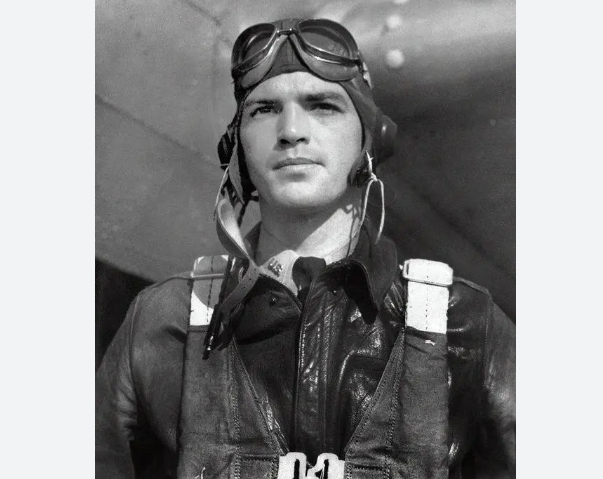
Three days after Pearl Harbor, America was still in shock. Families sat close to their radios, listening to reports they could barely believe. Ships had burned. Men had died. The country had been pulled into a war that suddenly felt close to every home, every town, every kitchen table. Across the Pacific, young pilots climbed into planes knowing that history had changed overnight, and one of those men was Captain Colin Kelly.
Kelly was not looking for fame. He was a husband, a father, a soldier, and a pilot who understood that orders did not wait for fear to pass. He had trained for dangerous missions, but nothing could fully prepare a man for the early chaos of war, when information was scattered, enemy movements were uncertain, and every flight could be the last. Still, when the call came, Kelly and his crew climbed aboard their B-17 Flying Fortress and took to the sky.
Their mission carried them over dangerous territory, where Japanese forces were advancing and American defenses were under enormous pressure. The B-17 was a powerful aircraft, but power did not make it invincible. In the sky, metal could burn, engines could fail, and one burst of enemy fire could turn a mission into a desperate fight for survival. Kelly knew this. So did every man sitting inside that aircraft.
As they approached their target area, tension filled the plane. The crew searched the sea below, watching for enemy ships. Every second mattered. Every movement had to be calm, precise, and disciplined. Then the moment came. Kelly brought the bomber into position and launched an attack against a Japanese warship. In those early days, when America desperately needed proof that it could strike back, the mission carried a weight larger than the men inside the plane could possibly know.
But war rarely gives heroes a clean ending.
Soon after the attack, Kelly’s B-17 was hit. The aircraft began to fail. Flames and damage spread through the bomber. The sky that had carried them moments before became a trap. Inside the plane, the crew faced the nightmare every airman feared: a burning aircraft, losing control, high above the earth, with only seconds to decide who might live.
Kelly understood the truth immediately. The plane was going down. He also understood something else: if he abandoned the controls too soon, his men might not have enough time to escape. A pilot’s instinct is to fight the aircraft, to hold it steady, to buy one more second, then another. And in those seconds, lives can be saved.
He ordered his crew to bail out.
One by one, the men moved toward survival. But survival was not simple. The plane was shaking, burning, and falling. Every man who escaped did so because someone remained behind long enough to keep the aircraft from becoming complete chaos. That man was Colin Kelly. He stayed at the controls while his crew jumped, holding a dying bomber in the air with everything he had left.
There was no applause in that moment. No newspaper headline. No medal ceremony. Only fire, smoke, noise, and a young pilot choosing duty over his own chance to live. Kelly had a family waiting somewhere far away. He had a future that should have been longer. He had every human reason to save himself. But his crew needed time, and he gave it to them.
Moments after the last chances had been spent, the B-17 exploded.
The blast ended Colin Kelly’s life, but it did not end his story. News of his sacrifice spread across a wounded nation that was searching for courage in the darkness after Pearl Harbor. His face appeared in newspapers. His name was spoken in schools, homes, churches, and military bases. Children wrote letters to his family. People who had never met him mourned him as if they had lost someone of their own.
To Americans at that time, Colin Kelly became more than a pilot. He became proof that courage still existed when the world seemed to be falling apart. He represented the kind of bravery that does not shout, does not boast, and does not ask who is watching. It simply acts when others need saving.
Yet, like many early war heroes, his name slowly faded as the conflict grew larger. New battles came. New headlines appeared. More men sacrificed everything. The war moved forward, and history became crowded with names. But fading from public memory does not make a sacrifice smaller. It only means the story must be told again.
Colin Kelly’s final flight matters because it reminds us what heroism often looks like in its purest form. It is not always victory. It is not always survival. Sometimes it is a man in a burning plane, keeping his hands on the controls because others still have a chance. Sometimes it is choosing to be last when every instinct screams to be first. Sometimes it is knowing that you may not make it home, but making sure someone else does.
His crew lived because he stayed.
That is the heart of the story. Not the headlines. Not the fame. Not even the title of America’s first hero of World War II. The heart of the story is a final decision made in the sky, under fire, with no time for speeches. Colin Kelly gave his men the gift of seconds, and those seconds became the rest of their lives.
Today, his name deserves to be remembered not as a forgotten headline, but as a symbol of sacrifice at the very beginning of America’s long road through World War II. He was first called a hero when the nation needed one. But he remains a hero because, in his last moments, he proved that courage is not the absence of fear. It is love, duty, and honor holding steady when everything is burning.