

Meine Frau wollte ständig mit neuen Männern schlafen und verlangte deshalb eine offene Ehe. Doch als ich ihr sagte, dass das auch bedeutet, dass ich mit anderen Frauen schlafen darf, gefiel ihr das plötzlich überhaupt nicht.

„Du liegst mir mehr am Herzen als alles andere“, flüsterte sie mit Tränen in den Augen. „Aber ich habe mit anderen Männern geschlafen… und ich möchte, dass du alles erfährst, bevor du entscheidest, ob du mich noch heiraten willst.“ Die Worte hingen schwer in der Luft. Simon starrte seine Verlobte Marissa über den Küchentisch hinweg … Read more

11 July 2026

The Secret Behind My Daughter’s Sunday Meetings

I always believed I knew my daughter better than anyone else. For eighteen years, I watched her grow from a little girl who held my hand everywhere into a young woman with her own dreams, opinions, and secrets. As a single mother and the owner of a growing creative retail company, I had spent most … Read more

11 July 2026

Cheating Wife Wanted an Open Marriage: I Turned the Tables on Her

“I love you more than anything,” she whispered, eyes shining with tears. “But I’ve been sleeping with other men… and I want you to know everything before you decide if you still want to marry me.” The words hung in the air like smoke from a dying fire. Simon stared at his fiancée Marissa across … Read more

11 July 2026

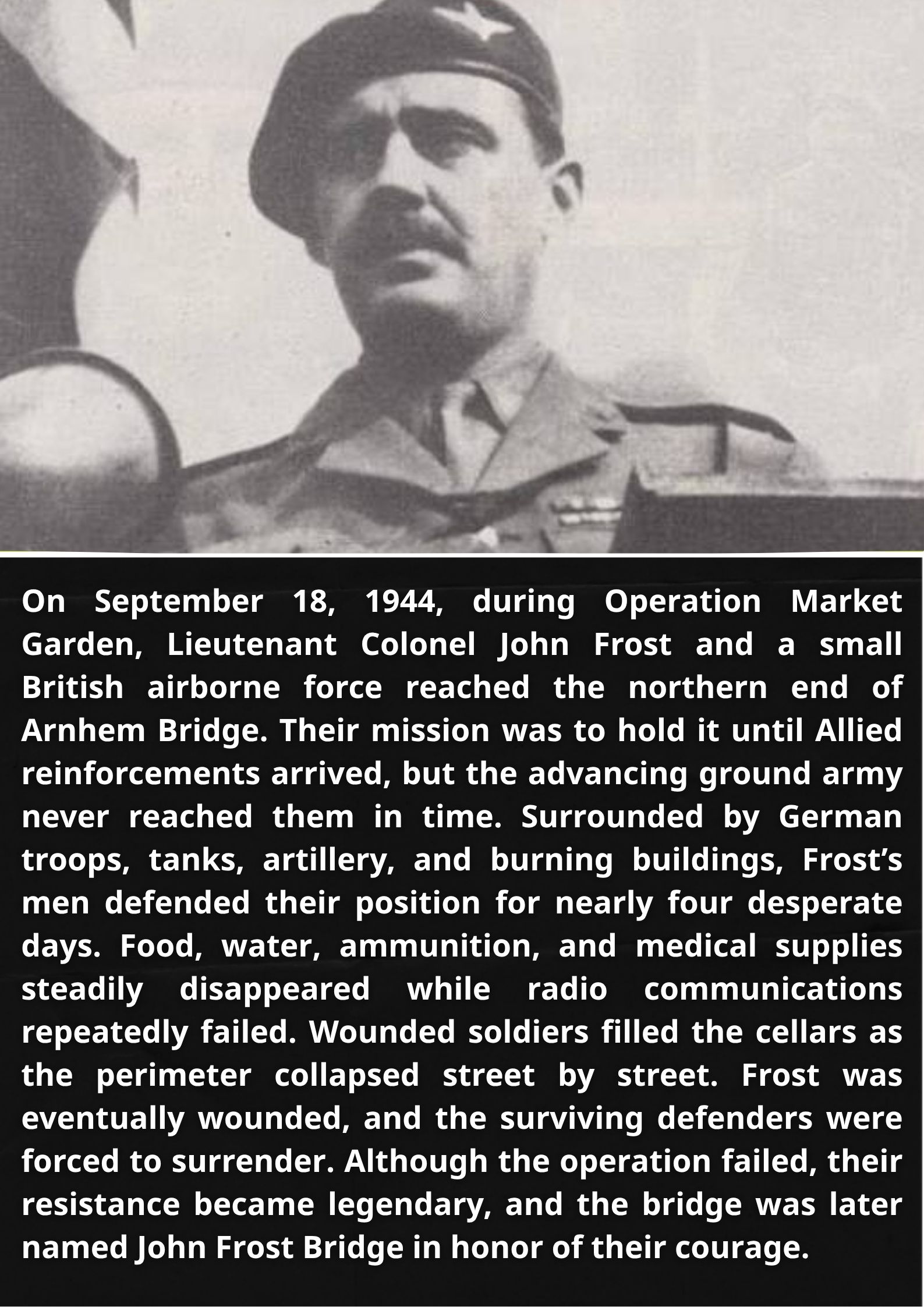
Four Days at Arnhem: John Frost and the Soldiers Who Refused to Break

On September 18, 1944, British paratroopers moved through the streets of Arnhem carrying one of the most important missions of Operation Market Garden. Their goal was to seize the great road bridge across the Lower Rhine and hold it until Allied ground forces arrived from the south. If the plan succeeded, the Allies hoped to cross the major rivers of the Netherlands, bypass Germany’s strongest defensive positions, and open a direct route toward the industrial heart of the Third Reich.

Among the British officers leading the advance was Lieutenant Colonel John Dutton Frost, commander of the 2nd Battalion, Parachute Regiment. Frost was an experienced airborne officer who understood both the ambition and danger of the operation. His men had landed west of Arnhem as part of the British 1st Airborne Division. From there, they were expected to move rapidly into the city and capture the bridge before German forces could organize a defense.

The plan looked simple on paper. Airborne troops would seize a series of bridges, while the British XXX Corps advanced along a narrow highway to relieve them. But almost immediately, problems appeared. The landing zones were several miles from Arnhem Bridge, communications were unreliable, and German resistance was much stronger than Allied planners had expected.John Frost - TracesOfWar.com

Many British units were delayed or blocked before reaching the city. Frost’s battalion, however, managed to push through. By the evening of September 17, part of his force had reached the northern end of Arnhem Bridge. They occupied houses, offices, and buildings overlooking the roadway, creating a defensive perimeter around the bridge approach.

Frost had reached the objective, but only a fraction of the expected British force was with him.

The soldiers knew they could not hold the position indefinitely. Their task was to defend the bridge until XXX Corps arrived. According to the operational timetable, relief should have come quickly. Yet the ground advance from the south became trapped by traffic, destroyed bridges, narrow roads, and determined German counterattacks.

At Arnhem, Frost and his men waited.

The Germans soon understood that British paratroopers had captured the northern approach. Armored vehicles attempted to cross the bridge, but British defenders opened fire. In one dramatic encounter, a German reconnaissance column charged across the bridge and was struck by rifles, machine guns, anti-tank weapons, and explosives. Several vehicles were destroyed, and the attack was broken.

But the defenders had revealed their position, and much heavier forces began closing around them.

German troops surrounded the buildings occupied by the British. Tanks and self-propelled guns moved into the streets. Artillery shells smashed walls, shattered windows, and set entire houses on fire. Snipers targeted anyone who moved between buildings. German infantry attacked repeatedly, attempting to divide the perimeter and eliminate the isolated groups of paratroopers.

The British soldiers turned ordinary houses into fortresses. They fired from upper windows, staircases, basements, and holes blasted through walls. When one position became impossible to defend, they slipped through gardens or broken buildings to another. Every room and street corner became part of the battlefield.John Frost: the face of the Battle of Arnhem - Market Garden - Battle of Arnhem

The situation grew worse with each passing hour. Ammunition began running low. Food and clean water became scarce. Medical supplies were quickly consumed as wounded men crowded into makeshift aid stations. Doctors and medics worked in dark rooms while shells exploded nearby. Some buildings caught fire, forcing injured soldiers to be moved under enemy fire.

Radio communication, already unreliable from the beginning, became increasingly difficult. Frost’s men struggled to contact the rest of the division and could not clearly determine when help might arrive. They could hear fighting elsewhere in Arnhem, but the main British force was unable to break through to the bridge.

Still, Frost’s soldiers continued to resist.

For nearly four days, the small force held the northern end of Arnhem Bridge against a much larger German concentration. Their position gradually shrank as one building after another was destroyed or captured. German commanders demanded surrender, but the British defenders repeatedly refused while they still possessed the means to fight.

The battle became one of endurance rather than maneuver. The paratroopers no longer fought to expand their position. They fought simply to survive another hour and delay the enemy for as long as possible.

Frost himself remained among his men, directing the defense while conditions collapsed around them. Eventually, he was seriously wounded by shellfire. He was taken to a medical position, where the number of casualties had become overwhelming.

By then, many of the defenders had almost no ammunition left. Their anti-tank weapons had been exhausted or destroyed, leaving them nearly helpless against German armor. Fires were spreading through the buildings, and wounded soldiers could not be evacuated. The promised relief force was still far away.

The survivors faced a terrible decision. Continuing the battle would mean the deaths of wounded men and defenders who could no longer resist effectively. Small groups attempted to escape through German lines, but many were captured. Others remained with the wounded and surrendered when further resistance became impossible.

Operation Market Garden continued elsewhere, but the attempt to secure a permanent bridgehead across the Lower Rhine failed. Arnhem became known as “a bridge too far,” a phrase later made famous through books and film. The operation had aimed to end the war more quickly, yet its planning depended on speed, reliable communications, and lightly defended objectives. At Arnhem, all three assumptions collapsed.

Frost survived his wounds and became a prisoner of war. After the war, his leadership and the courage of his battalion were widely honored. The defenders had not achieved their strategic objective, but their resistance became one of the most remembered episodes in British airborne history.

In 1978, the rebuilt bridge at Arnhem was officially named the John Frost Bridge. It remains a physical memorial not only to Frost but also to the soldiers who fought beside him, including those who were killed, wounded, or captured during the battle.

Their story is often remembered because it reveals the human cost hidden beneath military plans. On maps, Operation Market Garden appeared as a sequence of arrows, bridges, and timetables. At Arnhem, those plans became burning houses, wounded men, empty ammunition pouches, and soldiers waiting for reinforcements that never arrived.

John Frost and his men held their position until exhaustion, casualties, and overwhelming enemy power made resistance impossible. They could not change the final outcome of the operation, but their discipline and determination ensured that the defense of Arnhem Bridge would never be forgotten.
11 July 2026

60-jährige Kellnerin wird entlassen, weil sie dem als Obdachlosen verkleideten Besitzer hilft – am nächsten Tag passiert das Unglaubliche.

  Die Kellnerin, die alles verlor … weil sie Mitgefühl zeigte Wenn du Geschichten über Gerechtigkeit, Menschlichkeit und überraschende Wendungen liebst, dann begleite uns bis zum Ende. Denn manchmal verändert eine einzige gute Tat ein ganzes Leben – auf eine Weise, die niemand kommen sieht. „Sie sind entlassen. Sofort.“ Mit diesen vier Worten zerbrach das … Read more

11 July 2026

Ein CEO bewirbt sich undercover um einen Kredit bei seiner eigenen Bank – und erstarrt, als er hört, was zwei Kunden hinter ihm sagen.

Wenn ein Mann seine eigene Bank betritt und niemand ahnt, wer er wirklich ist, beginnt oft die gefährlichste Wahrheit genau dort, wo jeder nur Routine erwartet. Doch als er zufällig ein Gespräch zwischen zwei verzweifelten Kunden belauscht, begreift er, dass hinter den glänzenden Marmorböden ein dunkles Geheimnis verborgen liegt – eines, das Menschen ihre Zukunft … Read more

11 July 2026

MYSTERY STORY: THREE VANISHINGS THAT STILL DEFY LOGIC

1. The Perfect Circle in Death Valley

The desert does not need darkness to feel dangerous. In Death Valley, even moonlight can make the land look less like Earth and more like the surface of another world. That was what made the disappearance in 2021 so disturbing. Five experienced off-road drivers entered a remote stretch of desert on a clear night, with working GPS systems, satellite communication, extra fuel, and years of experience between them. They were not amateurs looking for thrills. They knew heat, distance, dust, silence, and the deadly confidence the desert gives before it takes everything back.

At 8:52 p.m., every vehicle stopped moving at the exact same time.

That was the last clear data point.

According to the recovered GPS logs, the group had been traveling in a loose line across a dry basin. There was no storm. No reported earthquake. No emergency beacon. No distress call. One moment, five signals were moving normally. The next, they all froze in place, clustered together in a spot that showed nothing unusual on the map. Seconds later, every signal vanished.

The first search team arrived the next morning. They expected to find broken vehicles, tire tracks, maybe footprints leading toward higher ground. Instead, they found nothing. No cars. No bodies. No scattered supplies. Even the tire marks faded strangely before reaching the final GPS point, as if the desert surface had been brushed smooth by an invisible hand.

For weeks, the search expanded. Helicopters scanned the basin. Rangers checked old mining roads. Volunteers walked mile after mile through heat and dust. Families begged for answers. But Death Valley gave back only silence.

Then the case went cold.

Two years later, drone surveyors mapping erosion patterns noticed something strange on the desert floor miles from the original search area. From above, it looked like a symbol: five tire tracks forming a nearly perfect circle. Not five separate trails leading into a circle. Five tracks already arranged there, evenly spaced, each stopping at the same invisible boundary.

The most chilling detail was simple.

There were no tracks leading in.

And none leading out.

When investigators reached the location, the ground inside the circle felt harder than the surrounding sand, almost baked smooth. Compasses reportedly behaved strangely near the center. One drone lost connection directly above it and dropped from the sky without warning. Its camera captured one final frame before shutting off: the empty desert floor, with five dark shadows stretched across the circle.

But there were no people standing there.

Families of the missing drivers hoped the discovery would finally solve the case, but it only deepened the mystery. No vehicle parts were found. No bones. No clothing. No fuel containers. No evidence of a crash or crime. Just the impossible circle, sitting under the same moonlit sky where five people had vanished.

Some called it a hoax. Others blamed wind, soft sand, GPS errors, or military testing. But locals who know the desert say there are places where sound disappears, where lights move in the distance, and where travelers sometimes feel they are being guided off the road by something that does not want to be seen.

Today, the perfect circle is rarely discussed officially. But among off-road drivers, the story still spreads as a warning: if your GPS freezes in Death Valley and the road ahead looks too smooth, turn back immediately.

Because some tracks are not made to lead anywhere.

They are made to close behind you.

2. The Valley That Echoed Twice

In 1936, seven explorers entered a remote valley in Patagonia and never came back. Their expedition had started as a mapping survey, a difficult but ordinary mission through cold terrain, jagged ridges, and wind-carved stone. The group was experienced, well supplied, and led by a man who had survived storms in places where maps were still more rumor than fact. Their final report came just before 6:44 p.m.

The message was strange enough that the radio operator asked them to repeat it.

“We found a valley where every sound echoes twice.”

At first, no one understood why that mattered. Patagonia is full of cliffs and empty spaces where echoes behave oddly. But the explorer speaking sounded frightened. He said their voices were returning once from the rocks—and then again from below the ground. The second echo was slower, lower, and not always saying the same words.

Then the transmission broke into static.

Search teams were delayed by weather and reached the valley days later. They expected signs of avalanche, injury, or panic. Instead, they found the camp almost perfectly preserved. Seven tents stood in a half-circle. Packs were stacked neatly. Tools lay beside a cold survey table. A pot of stew sat over the fire.

The food was still warm.

That detail was recorded quietly and later disputed, because it made no sense. The search party had arrived long after the explorers should have been gone. The fire beneath the pot was ash. No one had been there for days. Yet steam reportedly rose when the lid was lifted.

There were no footprints leaving camp.

No signs of struggle.

No blood.

No torn fabric.

Then a searcher noticed something buried beneath a drift of snow near the edge of the valley. It was a metal canteen. Then another. Then five more. Seven in total. Each belonged to one of the missing explorers, marked with initials.

Every canteen was full of seawater.

The valley was far from the coast.

The discovery frightened even the most rational members of the search team. The canteens had been empty when the expedition began, according to supply records. No ocean water should have been anywhere near that region. Yet the liquid inside reportedly smelled of salt and decay, as if drawn from deep water rather than shore.

The valley itself seemed wrong. Searchers reported hearing their own footsteps repeat twice. The first echo came naturally from surrounding stone. The second came from beneath the snow, slightly delayed. One man shouted the name of a missing explorer and heard it return once from the cliffs.

Then a second time from underground.

But the second echo whispered back, “Not missing.”

The search ended early after two team members became disoriented and claimed they saw lanterns moving below the ice. Official reports blamed severe terrain, weather confusion, and possible crevasses hidden under snow. But no bodies were ever recovered.

Years later, a diary from one searcher surfaced. In it, he wrote that the valley was not empty. He believed something beneath it was copying sound, studying voices, learning how to answer. His final note about the missing explorers was chilling: “They did not fall. They were called back by their own echoes.”

To this day, the valley’s exact location remains uncertain. Some say it was deliberately removed from later maps. Others believe the search team marked it incorrectly out of fear.

But old mountaineers still repeat one warning about that region: if your voice echoes twice, stop speaking.

Because the second voice may not be yours.

3. The Tracks That Kept Going

In 1971, eleven railway workers vanished in Siberia while laying new tracks through a remote forest. The work was brutal, cold, and isolating, but not unusual. Crews often lived for weeks in temporary camps, surrounded by snow, pine trees, and silence so deep it seemed to press against the ears. Their job was to extend a line through difficult ground toward a settlement that no longer exists on most modern maps.

The final radio message came at 1:11 a.m.

“The tracks keep going… but the ground doesn’t.”

The operator thought the man was drunk or exhausted. He asked him to repeat. Only static answered. Then, faintly, another voice came through, not officially identified as anyone on the crew.

“Do not follow the rails.”

By morning, contact was lost.

A maintenance team reached the site nineteen days later after heavy weather delayed access. What they found made no practical sense. The workers’ camp was intact. Coats hung on hooks. Food supplies remained. Tools were lined beside the unfinished track. The machinery was cold but undamaged. There were no signs of attack, fire, explosion, or animal disturbance.

The men were gone.

Then the searchers saw the helmets.

Eleven hard hats were lined up neatly beside the rails, one for each missing worker. They had not been thrown down in panic. They had been placed carefully, evenly spaced, facing the same direction. Inside every helmet was a thin layer of frost, despite the fact that the helmets had been found under covered equipment where snow could not easily fall.

One worker touched the frost and said it felt oily.

The rails themselves led into the forest as expected, but after several hundred meters, something impossible appeared. The ground beneath the track seemed to drop away into a shallow depression, yet the rails continued forward, perfectly level, unsupported for several feet before meeting earth again. It looked as if a section of land had vanished beneath them, but the tracks had refused to bend.

Searchers followed the line farther and found deep boot prints in the snow along both sides of the rails. The prints belonged to the missing men. They moved forward in orderly pairs, as if the crew had walked together into the forest.

Then the footprints stopped.

Not gradually. Not at a slope. They stopped in a straight line across the snow.

Beyond that point, the tracks continued into the trees.

No footprints followed.

The maintenance crew refused to continue after one of them claimed he heard hammering ahead. Slow metal strikes. The sound of someone still laying rails in the forest. But no workers were visible, and the sound moved farther away whenever they approached.

Officially, the disappearance was attributed to weather exposure, disorientation, or an undocumented accident. Unofficially, no one could explain why the camp had been left untouched, why the helmets were lined up, or why the last message described tracks continuing where the ground did not.

The railway extension was abandoned soon afterward.

Locals later claimed the area had always been cursed. Hunters avoided that forest because trails sometimes appeared overnight, leading toward places that were not there the day before. One story said the land itself was unstable, not physically, but spiritually—as if certain paths could lead out of the world if followed too far.

Years later, a railway inspector visited the abandoned site and reported hearing distant voices calling from beyond the old rails. One voice said, “Bring the next section.”

Another said, “We are almost there.”

Today, the forest has swallowed much of the route. But some people claim that on freezing nights, if you stand near the old line, you can still hear metal striking metal in the dark.

And if you follow the sound, the tracks keep going long after the ground ends.

11 July 2026