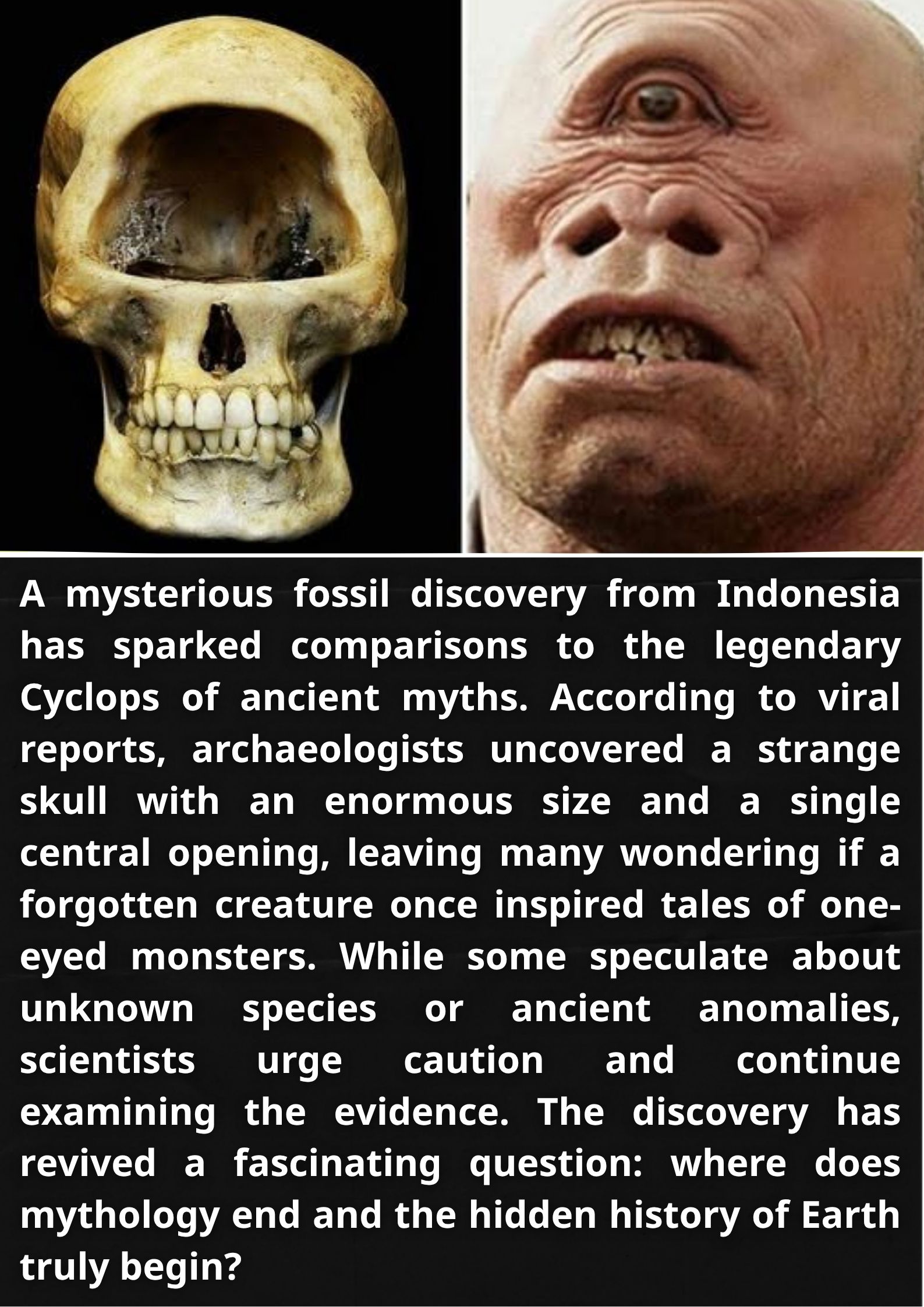
For centuries, stories of one-eyed giants have appeared in myths across different cultures. Among the most famous is the legend of the Cyclops—a powerful creature from ancient Greek mythology described as having a single enormous eye in the center of its forehead. These beings were portrayed as giants with incredible strength, living in caves and guarding mysterious lands.
Now, a dramatic claim from Indonesia has reignited fascination with these ancient stories. Viral reports have described the discovery of a strange fossilized skull, allegedly belonging to a giant one-eyed creature found deep inside a remote volcanic cave. The unusual appearance of the skull, especially its supposed single eye socket, has caused excitement among online communities and sparked questions about whether myths may have been inspired by real creatures from Earth’s distant past.
However, as with many extraordinary archaeological claims, the truth requires careful investigation.
The idea of a real “Cyclops” creature has fascinated scientists and historians for decades. Ancient myths often contain elements that may have been influenced by real observations of the natural world. People in the ancient past encountered fossils, unusual animals, and strange geological formations without modern scientific explanations. These discoveries may have contributed to stories of monsters, giants, and supernatural beings.
One of the most famous examples involves ancient elephant fossils. Some researchers believe that the skulls of prehistoric elephants, especially dwarf elephant species found on Mediterranean islands, may have inspired stories of Cyclopes. Elephant skulls contain a large central nasal opening that, when viewed without knowledge of anatomy, could appear similar to a giant eye socket.
To ancient people, discovering such a massive skull buried in the earth may have seemed like evidence of a forgotten race of monsters.
The reported Indonesian discovery follows a similar pattern: a mysterious object appears, its unusual features capture public imagination, and connections are quickly made to legendary creatures. A large skull with an unusual opening naturally invites comparisons to mythical beings, especially when found in a dramatic location such as a volcanic cave.
Indonesia itself is a region rich in prehistoric discoveries. The islands contain evidence of ancient human populations, extinct animals, and unique evolutionary histories. Fossils from the region have helped scientists understand how species adapted to isolated environments over millions of years.
The famous discovery of Homo floresiensis, sometimes called the “hobbit” species, on the island of Flores demonstrated that human evolution was more diverse than previously believed. Researchers uncovered remains of a small-bodied human relative that lived thousands of years ago, challenging traditional assumptions about ancient humans.
Indonesia has also produced discoveries of extinct animals, including giant reptiles, ancient mammals, and other unusual species. The region’s volcanic landscapes preserve valuable fossils, making it an important area for archaeological and paleontological research.
Yet a strange appearance alone does not prove the existence of a mythical creature.
Scientists studying fossils rely on detailed evidence. They examine bone structure, geological layers, dating methods, and comparisons with known species. A skull must be carefully analyzed to determine what animal it belonged to, how old it is, and whether its unusual features are natural or the result of damage, erosion, or misinterpretation.
A single opening in a skull, for example, does not automatically represent an eye socket. Many animals have anatomical structures that can appear mysterious when separated from their full context. Without scientific examination, even a real fossil can be misunderstood.
The fascination surrounding the alleged “Cyclops skull” reveals something deeper about human curiosity. People have always searched for connections between the unknown and the stories passed down through generations. When a discovery appears to match an ancient legend, it creates a powerful emotional reaction because it seems to bring fantasy closer to reality.
The possibility that myths may contain traces of real events is not completely impossible. Legends are often shaped by human experiences, environmental changes, encounters with unfamiliar animals, and discoveries of natural objects. Ancient storytellers transformed these experiences into narratives filled with heroes, monsters, gods, and mysteries.
But the relationship between myth and science is complex.
Archaeologists do not search for evidence to prove legends literally true. Instead, they investigate how human societies created stories and how those stories may reflect their understanding of the world around them. A myth can contain historical memories, symbolic meanings, or imagination inspired by real observations.
The Cyclops legend itself is a perfect example. Whether inspired by fossil discoveries, misunderstood animals, or pure imagination, it has survived for thousands of years because it represents a universal human fascination with the unknown.
A real prehistoric creature with one eye remains unsupported by scientific evidence. Evolutionary biology shows that complex vision systems and skull structures develop through specific processes, and no confirmed animal matching the legendary Cyclops has ever been discovered.
However, the search for unusual fossils continues. Earth’s history is filled with creatures that once seemed impossible. Giant reptiles, massive mammals, and strange extinct species have all been revealed through scientific discovery. Each new fossil reminds us that reality can sometimes be stranger than fiction.
The alleged Indonesian discovery, whether confirmed or eventually explained as a misunderstanding, highlights the enduring power of archaeology and paleontology. Every fossil carries a story, but understanding that story requires patience, research, and evidence.
Perhaps the greatest mystery is not whether a one-eyed monster once walked the Earth. It is how a single unusual discovery can awaken ancient fears, forgotten legends, and humanity’s endless desire to uncover secrets hidden beneath the surface.
From the darkest caves to the deepest layers of rock, the planet still holds countless mysteries waiting to be discovered. Some may confirm what we know. Others may completely change our understanding of the past.
And sometimes, the most fascinating discoveries are not the ones that prove myths were real—but the ones that reveal why humans created those myths in the first place.