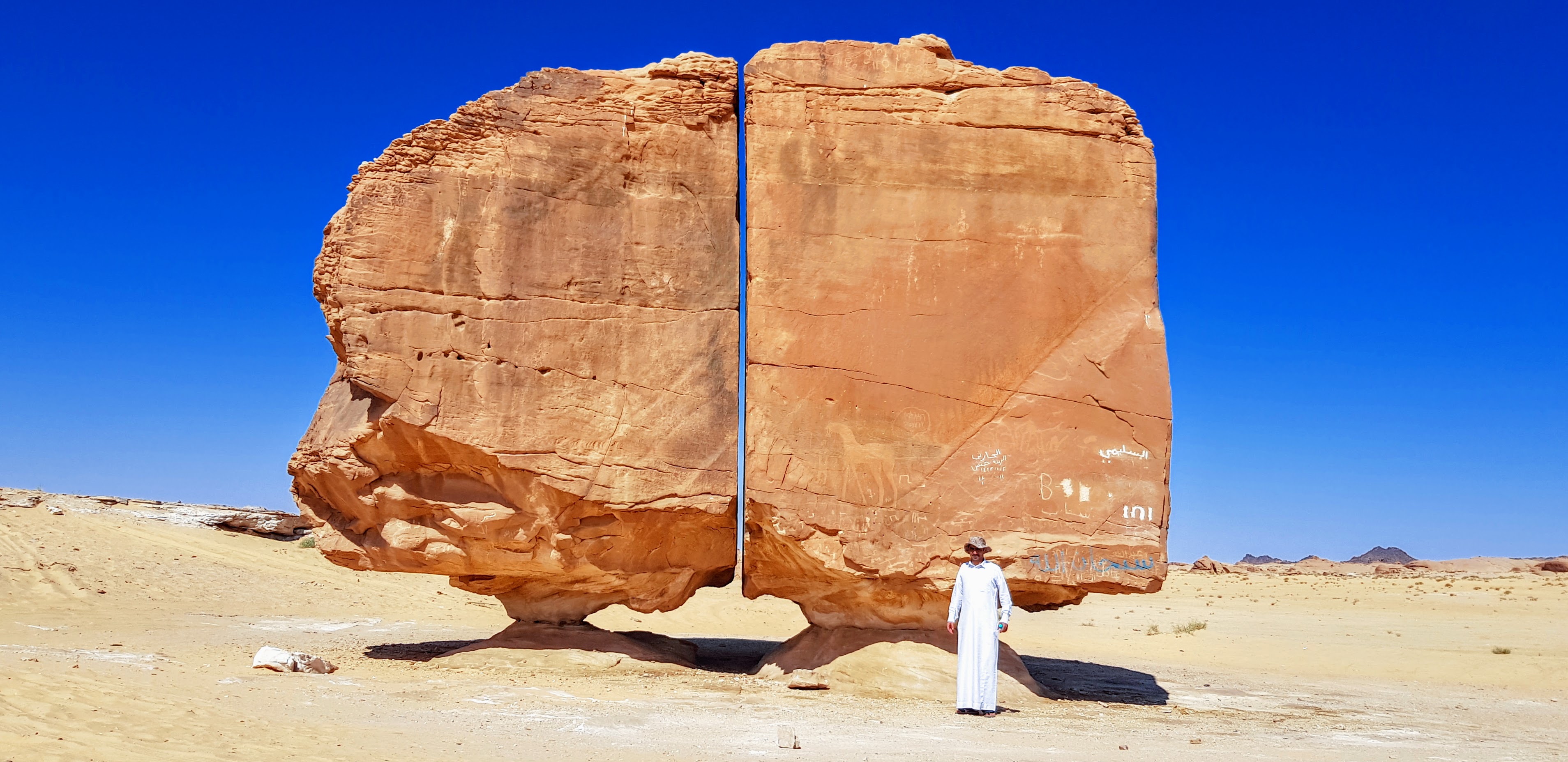
In the vast desert landscape of northwestern Saudi Arabia, around 50 kilometers south of the Tayma oasis, stands one of the region’s most extraordinary natural formations. Known as Al Naslaa, the massive sandstone boulder appears to have been cut directly down the middle by an invisible blade. The gap is narrow, vertical, and astonishingly straight, separating the stone into two enormous halves that seem almost perfectly matched.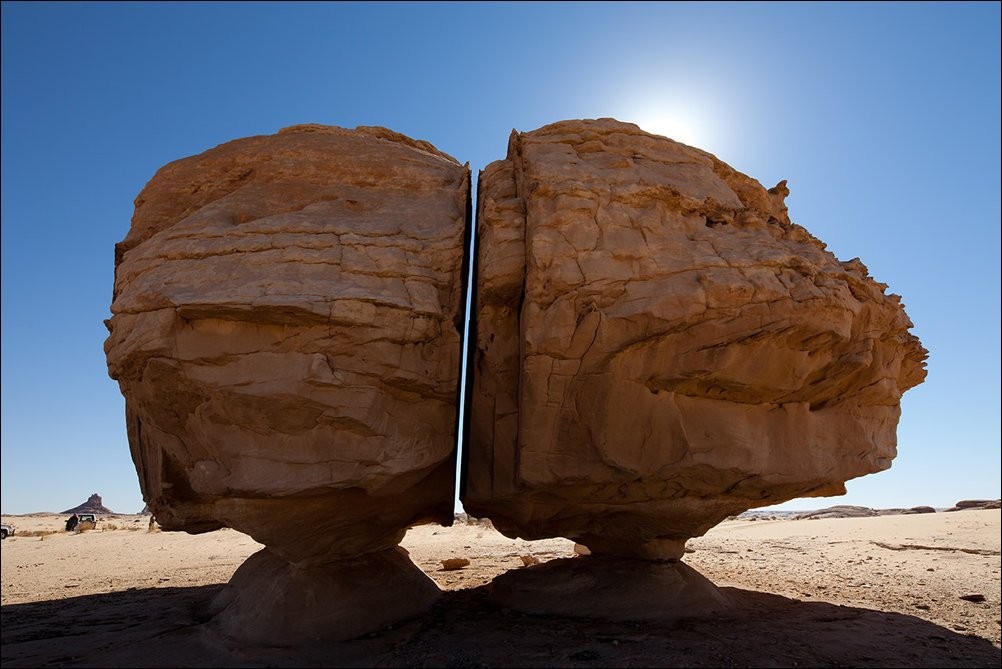
What makes the formation even more remarkable is the way both sections rest on slender natural bases. Instead of collapsing toward each other or leaning into the divide, the two halves remain balanced on separate stone pedestals. From certain angles, they appear to float above the desert floor, held in place by supports that look far too small for their size.
The formation is estimated to stand around six meters tall and nine meters wide. Its imposing scale immediately attracts attention, but it is the precision of the central split that has turned Al Naslaa into an international mystery. Photographs of the site often cause viewers to question whether the line could truly have been produced by natural forces.
The edges of the crack appear unusually smooth and consistent. There are no large missing sections, no chaotic breakage, and no obvious signs of an uneven collapse. The gap runs almost continuously from the top of the boulder to the bottom, giving the impression that the rock was divided deliberately.
Yet there is no accepted evidence that ancient people possessed a tool capable of slicing through a sandstone mass of this size with such accuracy. This has made Al Naslaa a favorite subject for speculation, especially among those who believe lost technology or unknown civilizations may have shaped it.
The surrounding region adds another layer of fascination. Tayma was an important ancient settlement and a crossroads for trade routes that connected Arabia with Mesopotamia, the Levant, and other parts of the ancient world. Caravans carrying incense, metals, textiles, and precious goods would have passed through the area for centuries.
The southeastern face of Al Naslaa contains petroglyphs, including images commonly interpreted as horses, ibex, and other animals. Some markings in the wider region are associated with ancient North Arabian inscriptions, including traditions often described as Thamudic. These carvings show that people visited or lived near the formation thousands of years ago.
The rock may have served as a landmark, meeting place, symbolic site, or simply a striking feature that inspired travelers to leave their marks. Although the carvings do not explain the split, their presence proves that Al Naslaa had captured human attention long before modern photographs made it famous.
Geologists generally favor natural explanations. One theory proposes that the rock formed along a fracture or joint already present inside the sandstone. Geological forces may have created a weak vertical line, and movement in the ground could later have caused the boulder to separate along that point.
A fault beneath or near the formation may also have contributed. Even small shifts in the earth can place enormous pressure on rock. If stress builds along a natural weakness, a large stone mass can crack in a surprisingly clean pattern.
Another possibility involves repeated temperature changes. Desert environments experience intense heat during the day and much colder conditions at night. Over long periods, expansion and contraction can weaken rock surfaces. Water entering tiny fractures can also contribute to erosion, especially if rare rainfall is followed by rapid evaporation or temperature changes.
Wind may have played a major role after the original crack formed. Sand carried through the narrow opening could have polished the surfaces for centuries or even millennia. Like natural sandpaper, windblown particles may have gradually smoothed the opposing faces, making the divide look more precise than it was when it first appeared.
The delicate pedestals beneath the boulder can also be explained through differential erosion. Softer layers of sandstone may erode more quickly than harder sections. Over time, wind and sand could remove material around the base while leaving stronger stone behind. This process can create mushroom-shaped rocks, narrow supports, and seemingly unstable formations across desert landscapes.
Even so, Al Naslaa continues to resist a single explanation that satisfies every observer. Natural forces can produce remarkably straight fractures, but the combination of the clean divide, matching halves, and balanced pedestals appears almost too perfect.
This uncertainty has encouraged more imaginative theories. Some claim the stone was cut by an advanced ancient civilization using technology that has since been lost. Others have suggested extraterrestrial involvement, arguing that the formation looks more manufactured than geological.
There is currently no archaeological evidence supporting those ideas. No tools, machinery, cut marks, or nearby remains have been identified that prove human or nonhuman engineering. The strange appearance alone is not enough to establish artificial construction.
Still, such theories reveal something important about the human response to mystery. When nature creates a form that looks intentional, people naturally search for an intelligence behind it. Straight lines, symmetry, and balance are usually associated with design, so Al Naslaa challenges our expectations of what natural processes can achieve.
The exact age of the sandstone is often estimated in the hundreds of millions of years, though the split itself would be far younger than the rock. The boulder may have stood intact for an immense period before finally separating. The fracture could have happened gradually, suddenly, or through several stages of geological stress and erosion.
Without detailed analysis of the internal structure, mineral composition, fracture surfaces, and surrounding bedrock, it is difficult to reconstruct the full sequence of events. Even advanced geological study might not produce a complete answer because much of the evidence has already been altered by time.
Al Naslaa is therefore both a geological formation and an archaeological landscape. The rock itself records natural history, while the carvings on its surface preserve traces of human presence. Together, they connect two different timelines: the slow transformation of the earth and the brief passage of people across it.
For ancient travelers, the split stone may have seemed just as mysterious as it does today. They may have considered it sacred, dangerous, powerful, or simply unforgettable. The petroglyphs suggest that people did more than pass by—they stopped, observed, and marked the place.
Today, Al Naslaa remains one of Saudi Arabia’s most photographed natural wonders. Visitors stand before the narrow gap, examining its smooth edges and fragile-looking supports. Some leave convinced that geology provides the answer. Others depart believing that something unexplained happened there.
The most intriguing possibility may be that both reactions are part of the formation’s power. Al Naslaa does not need to be artificial to be extraordinary. Nature has created countless structures that appear engineered, from hexagonal stone columns to perfectly round rocks and massive arches.
Yet the desert has not fully surrendered the story of this one. The central crack remains silent. The petroglyphs offer no explanation. The wind continues to move sand through the gap exactly as it may have done for thousands of years.
Perhaps future research will identify the precise forces that divided the boulder. Until then, Al Naslaa will remain suspended between science and mystery—a giant stone opened like a book, with its most important page still unread.