Part 1
Michael Harrow had seen the house long before he bought it. Not in a listing. Not in a newspaper. Not while driving through town. He had seen it in his dreams for ten years, always the same way: a narrow gray house under heavy rain, one upstairs window glowing yellow, and the number 666 nailed crookedly beside the front door. In every dream, he stood outside in the cold, unable to move, while someone whispered from behind the door, “You’re late.”
At first, Michael told nobody. He was thirty-four, practical, tired, and not the kind of man who believed dreams meant anything. But the dream kept returning whenever his life was about to change. He dreamed it before his father died. He dreamed it before losing his job. He dreamed it the night his engagement ended. Each time, the house looked closer. Each time, the whisper sounded more impatient.
When he finally bought a home in a quiet town outside Cleveland, he thought the nightmares would end. The place was cheap, old, and strangely available, but he convinced himself luck had finally turned in his favor. The agent said the previous owner had moved suddenly and wanted a quick sale. Michael did not ask too many questions. He only wanted somewhere silent.
On moving day, he parked in the driveway and stared at the house. For one second, his heart seemed to stop. The gray walls. The narrow porch. The upstairs window. It was not raining, but everything else was exactly as he had dreamed.
Then he saw the address plate.
666.
Michael laughed once, dry and nervous. “No,” he whispered. He checked the papers again. The address was correct. He stood on the porch for several minutes before unlocking the door. Inside, the house smelled of dust, old wood, and something faintly sweet, like flowers left too long in water.
That first night, Michael slept on a mattress in the living room. At 3:00 AM, he woke to knocking.
Not at the door.
Inside the wall.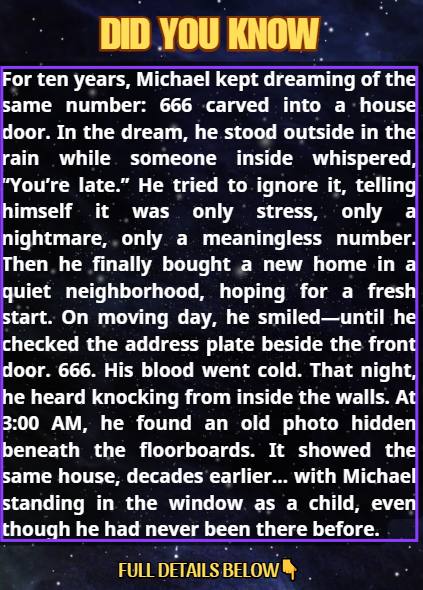
Three slow knocks came from behind the plaster near the staircase. Michael sat up, holding his breath. The knocking came again, lower this time, as if someone were moving downward behind the wall.
The next morning, he blamed pipes. Old houses made sounds. He repeated that sentence until he almost believed it. But while unpacking in the upstairs bedroom, he noticed one floorboard near the closet was loose. When he pried it open, he found a sealed envelope hidden underneath.
Inside was an old photograph.
It showed the house decades earlier, black and white, with a family standing on the porch. A mother. A father. A little girl. And in the upstairs window, behind the curtain, stood a boy who looked exactly like Michael as a child.
Michael dropped the photo.
He had never been in that house before. He had not even grown up in that state.
On the back of the photograph, written in faded ink, were six words:
He always comes back at thirty-four.
Michael did not sleep the next night. He sat in the kitchen with every light on, staring at the photograph. At 2:59 AM, the lights flickered. At 3:00 AM, the knocking began again. This time, it came from the basement door.
Then a child’s voice whispered from the other side.
“Michael… you’re late.”
Part 2
Michael called a contractor the next morning and asked him to inspect the basement. The man arrived cheerful, carrying tools and coffee, but his mood changed the moment he saw the door. He asked how long Michael had lived there. Michael said two days. The contractor nodded slowly and said, “Then you still have time.”
Michael grabbed his arm. “Time for what?”
The contractor would not answer. He only said the previous owner had covered the basement wall with new panels before selling the house. “People don’t hide clean walls in old basements unless something behind them is worse.”
They went downstairs together. The basement was colder than the rest of the house. Against the far wall, behind stacked boxes left by the previous owner, they found a section of paneling that did not match. The contractor pulled it away.
Behind it were names.
Dozens of names scratched into the concrete.
Each name had an age beside it.
Every age was 34.
Michael stepped closer, barely breathing, until he found the last name at the bottom.
MICHAEL HARROW — 34
The contractor whispered, “I’m leaving.”
Before Michael could stop him, the basement door slammed shut above them. The lights went out. In the dark, something knocked from inside the concrete wall. Three slow knocks.
Then the child’s voice came again, no longer behind the basement door, but directly beside Michael’s ear.
“You found the list.”
The contractor screamed. Michael felt him rush past in the dark, pounding up the stairs. The basement door opened suddenly, though no one touched it. The contractor ran outside and never returned. Michael stood frozen below, staring at the wall as the lights flickered back on.
One name had changed.
His own.
The scratched letters were wet now, as if freshly carved.
That evening, Michael searched town records. The house had been built in 1906. Six owners had died there. All men. All thirty-four. Every death was listed differently: fall, fever, accident, heart failure, disappearance. But one detail connected them. Each man had reported dreams about the house before moving in.
Michael found the previous owner’s name: David Keller. Still alive. He tracked him to a motel three towns away and drove there immediately.
David opened the door with a chain still latched. He looked older than his file photo, pale and hollow-eyed. When Michael said the address, David tried to shut the door. Michael begged him.
“I saw my name in the basement.”
David stopped.
He let Michael in and told him the story. The number was not just an address. It was a marker. The house did not belong to the people who bought it. It chose them. Every man who moved in at thirty-four had once appeared in an old photograph hidden somewhere in the house. David had found his own photo too. He survived only because he left before the seventh night.
“What happens on the seventh night?” Michael asked.
David looked at him with pity. “The house remembers where it put you.”
Michael drove back, planning only to grab his keys and leave. But when he entered, the house was different. The hallway seemed longer. The windows showed rain, though outside the sky was clear. From upstairs came the sound of a child laughing.
Michael ran for the front door.
It would not open.
At 3:00 AM, every light died.
A yellow glow appeared upstairs.
Michael turned slowly and saw a little boy standing on the staircase. The boy looked exactly like him at seven years old. In one hand, he held the old photograph. In the other, he held a rusted nail.
“You left me in the picture,” the child whispered.
Michael backed away. “Who are you?”
The boy smiled. “The first Michael.”
The walls began to knock. Not once. Not twice. Hundreds of knocks, from every room, every floor, every hidden space. The house shook with them. Then the basement door opened by itself.
On the stairs below, a line of men stood in the darkness. Pale faces. Hollow eyes. All thirty-four. All waiting.
Michael understood then. The house did not kill its owners. It copied them. Trapped one version inside and let the next version live until it came back.
He grabbed the rusted nail from the child’s hand and drove it into the address plate beside the front door. The number 666 cracked down the middle. The house screamed—not with one voice, but with many.
The door burst open.
Michael ran into the street just as the windows shattered behind him. When police arrived, the house was silent. The basement wall was blank. No names. No photos. No proof.
But Michael never bought another home.
Years later, he received an envelope with no return address. Inside was a new photograph of the gray house. The address plate had been repaired.
And in the upstairs window stood a man who looked exactly like Michael.
Only older.
On the back, someone had written:
You are late again.