Part 2
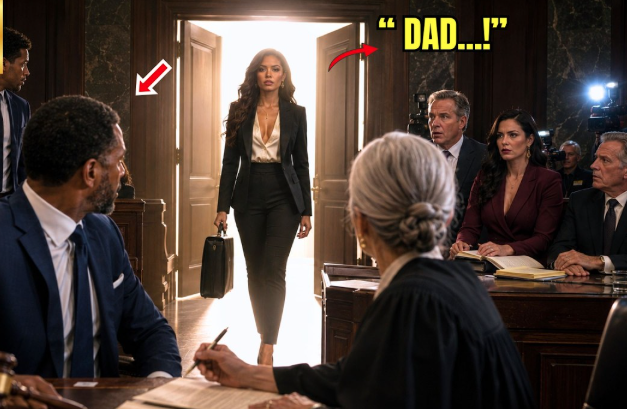
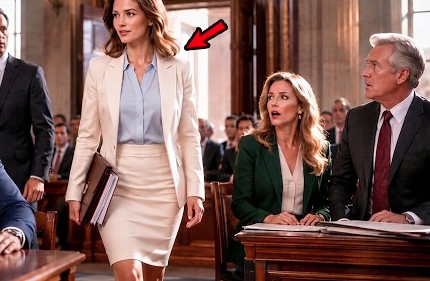
…A young woman in a crisp dark suit strode confidently down the aisle, an old leather portfolio tucked under her arm. The entire courtroom fell silent as Willa Brooks Calder announced herself as counsel for the defense.

Barton Kingsley’s lawyers immediately objected, citing her obvious conflict of interest. Willa remained calm and professional. “Since the plaintiffs made my adoption and my relationship with my father the centerpiece of their attack,” she said coolly, “I have every right to defend the truth.”
Judge Margaret Ellison allowed her to proceed.
Willa placed the original Calder Founders Trust document before the court. With precise, powerful words, she proved that Mason had not stolen from the company — he had protected it. Years earlier, he had placed a portion of his founding shares into a trust designed to safeguard the company’s principles from exactly the kind of hostile takeover now unfolding. Willa was not the beneficiary of fraud. She was the named guardian of that trust.
The room shifted.
She then presented a handwritten letter from Mason, formally attached to the trust, which stated that any attempt to use Willa’s past against the family would trigger the trust’s protective clauses. The very weapon Kingsley and Van Dornne had tried to use against Mason had backfired spectacularly.
Willa didn’t stop there.
She revealed internal messages between Kingsley and Priscilla Van Dornne plotting to drive down the company’s value. She exposed a suspicious payment from Van Dornne’s shell company to Kingsley on the very day the lawsuit was filed. And most devastatingly, she played a recorded conversation in which Van Dornne’s intermediary had offered Willa money and a prestigious job — on the condition that she stay silent and not appear in court.
The judge’s expression hardened. The momentum in the room had completely reversed.
In a landmark ruling, Judge Ellison suspended the sale, removed Barton Kingsley from the board, froze any dealings with Van Dornne Equity, and formally recognized Willa as the temporary protector of the founding voting authority. The empire was saved.
After the hearing, in the quiet marble hallway outside the courtroom, Mason and Willa finally stood face to face.
“I thought you had left me,” Mason said, his voice thick with emotion.
Willa gave him a small, steady smile — the same quiet strength he had seen in her as a child.
“I learned from the best. When they build a trap at the front door… you go in through the back.”
She reached into her pocket and pressed the old house key — the very one he had given her fifteen years earlier — into his hand.
“You gave me a home when I had none,” she whispered. “Today, I’m giving you back the key to everything you built.”
Mason closed his fingers around the worn key, his eyes shining. The $900 million empire was intact, but far more important was the promise that had never been broken.
In the weeks that followed, Kingsley and Van Dornne faced investigations. The board was cleaned up. Graham took on a greater role, June Holloway ensured full transparency, and Willa became special legal counsel to the Founders Trust.
One bright morning at the harbor pier where Mason had once worked as a simple mechanic, he addressed his entire company. Willa stood proudly beside him as he reminded every worker, driver, and employee of the simple truth their company was built on:
In this house, nobody gets left out in the rain.
The End.