I had been in back-to-back quarterly reviews all afternoon when Marcus knocked on my door, twice, a gesture he never made during meetings. Instantly, I sensed something was off before he even spoke. “There’s a child in the lobby,” he said. “She’s been waiting for 40 minutes. She says she needs to speak with you.” I didn’t look up. Send her back, I thought. Someone must have brought her, but Marcus shook his head. No one brought her, sir. She came alone. She’s seven, maybe eight, and she has a handwritten note with your name on it. The room went quiet. My junior partners exchanged glances that meant nothing outwardly, but I could see their attention. I set down my pen and told Marcus to have her leave the note at reception and go home. She said she would wait. I hesitated, trying to follow protocol, but something in Marcus’s expression, the slight tension around his jaw and the careful blankness, made me realize he was choosing his words carefully. Fine, I said. Five minutes. Put her in the small boardroom. Marcus nodded, and I excused myself from the meeting, walking down the hall past floor-to-ceiling windows that revealed the gray November skyline of Halifax.
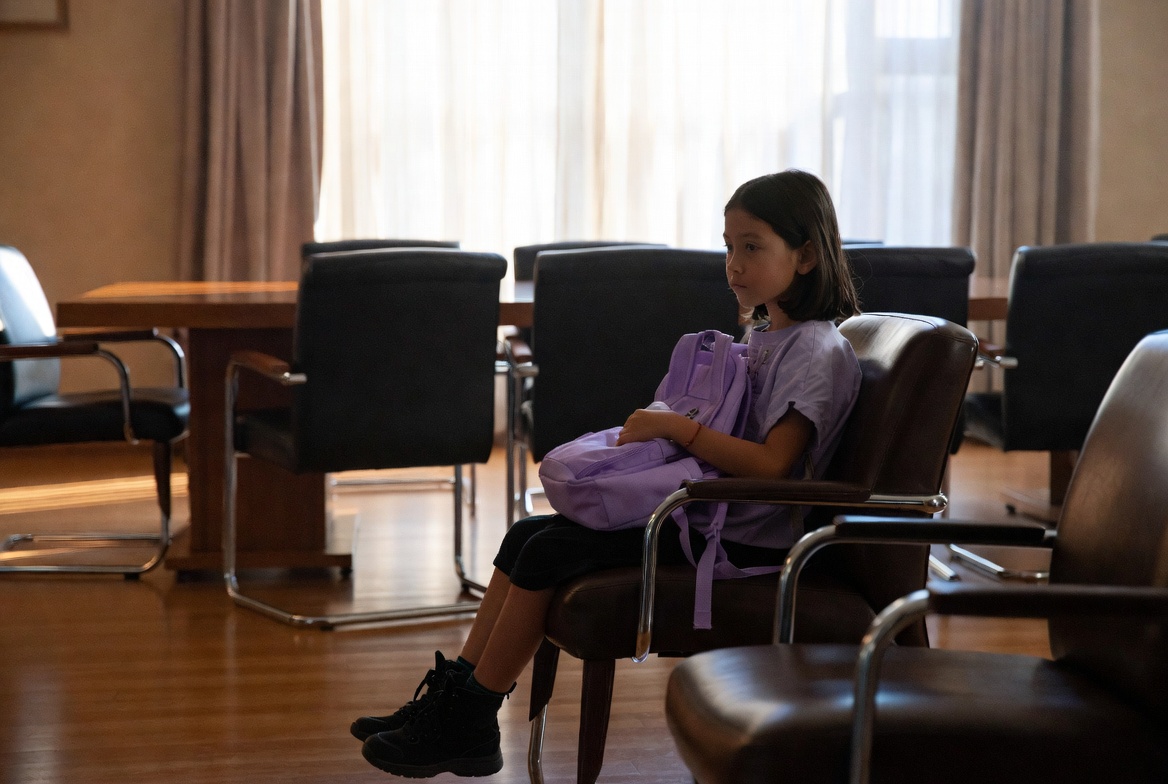
When I opened the boardroom door, she was sitting perfectly straight in a leather chair, her feet dangling, a purple backpack on her lap, hands folded. She looked directly at me without flinching. Most adults reacted nervously in my presence, but not her. I sat across from her, maintaining my usual calm, because children respond better when treated like small adults rather than with softened voices. “I’m told you asked for me by name,” I said. “Yes,” she said steadily. “You’re Mr. Crane. You own this building. My mom works for you. Patrice Odum. Fourth floor.” I knew many employees but not all; she paused and continued. “She’s been sick. Not like a cold. Sick like tired all the way through. She works late and brings work home after she thinks I’m in bed. I’m not usually in bed. I just pretend so she doesn’t feel bad.” I listened silently, realizing her awareness and worry exceeded most adults I knew. “Last week she fell asleep standing at the stove. She didn’t burn herself, but she could have.” She looked at me carefully, not accusing, just factual. Her seriousness, her focus on truth without embellishment, unsettled me in a way I didn’t expect. “What’s your name?” I asked. “Cleo,” she said. “How old are you?” “Eight. Nine in March.” She had taken a bus, walked three blocks, and prepared by researching me and my appearance to ensure she spoke to the right person. “Your mother doesn’t know,” I said. “She’d think she did something wrong.” “She doesn’t,” Cleo said firmly, with a composure that was almost impossible for her age.
I asked her why she came. She unzipped her backpack and placed a folded sheet of lined paper on the table. “I wrote it down,” she said, “so I wouldn’t forget or get nervous.” Her voice was careful and deliberate. I encouraged her to speak if she wanted. She took a deep breath and read aloud. “Can you please give my mom one day off? Not a vacation day, because she won’t take it if she thinks it counts against her. A real day where she doesn’t come in and has to listen. She listens to you more than she listens to me. I want to make her breakfast. Toast and scrambled eggs. At the table. Without her laptop open.” She looked at her hands for the first time, acknowledging the weight of her words. The room went silent. I sat back, considering the small but profound request, realizing this child had noticed something no one else had. She had seen the quiet exhaustion, the relentless commitment, and the absence of recognition. She had taken it upon herself to advocate for her mother in the most direct, thoughtful way possible.

I asked her about her mother beyond work. She spoke about Patrice’s humor, her creativity, her ability to fix things with limited resources. She recalled songs Patrice made about vegetables, broken toys, even her elderly neighbor’s gate. Cleo’s observation was simple yet striking: her mother cared for everyone, yet no one seemed to notice. I realized that the same qualities I admired in reliable employees were often invisible in daily life, and yet this child had noticed everything. I stood, walked to the window, and remembered my own mother, Edith Crane, who had raised me and my sister alone. She had carried unseen burdens, worked tirelessly, and left a quiet strength behind that I had not fully recognized until now. Cleo reminded me of that same essence, the invisible weight carried with grace, dedication, and love.

I instructed Marcus to ensure Cleo had everything she needed while she waited, and I returned to the boardroom to review Patrice’s file. Thirty-four, hired four and a half years ago, promoted eighteen months later, flawless attendance aside from a compassionate leave, performance reviews marked strong or exceptional, with supervisor notes praising her reliability, thoroughness, and initiative. I had read similar files countless times, but now, with the child’s testimony freshly in mind, the words resonated differently. The phrases about “going above and beyond” were no longer bland HR jargon; they were evidence of a life quietly devoted to others, unseen yet impactful.
When Cleo returned to the room after the bus ride, she recounted her observations in person, carefully, with the seriousness of a child who understood more than she should. She described her mother’s care for the family, the attention to detail, the silent sacrifices. Elliot Crane, who rarely accommodated emotions in procedural matters, listened without interruption, allowing the depth of her insight to sink in. She requested nothing for herself, only that her mother be acknowledged, respected, and given a brief reprieve. I realized that leadership is not only about managing systems and enforcing rules; it is about noticing the unnoticed, valuing the invisible efforts, and responding with humanity. Cleo had reminded me, in the most direct and honest way, that even small actions, like allowing a mother a day of rest or a child’s simple breakfast, carried weight far beyond their apparent simplicity.

In the following weeks, I implemented meaningful changes. I instituted structured workload reviews, mandatory time-off policies, and genuine well-being audits. I ensured that employees, especially those like Patrice, had their efforts recognized and their humanity respected. I understood, finally, that a company thrives not solely through processes and metrics but through acknowledgment, empathy, and the quiet support that allows people to flourish. And in that small boardroom on a Tuesday in November, with a child advocating for her mother, I discovered the profound impact of seeing, listening, and acting on what truly matters in life.
Cleo’s small, deliberate presence had changed the way I led, the way I observed, and the way I valued the people who make everything possible. The impact of one child, one carefully thought-out request, would ripple through the company and my perspective for years to come, reminding me that leadership is as much about heart as it is about strategy.