The night started with rain, laughter, and a bag full of overpriced things my sister swore she needed.
It was supposed to be simple.
My sister, Naomi, had come to Manhattan for the weekend after a messy breakup, and I wanted to give her one normal night where she didn’t have to think about lawyers, moving boxes, or the fact that the man she had almost married had quietly emptied half their savings account before leaving. So I took her to a small Italian restaurant near the Village, then to a few shops, then for coffee because she said she wasn’t ready to go back to the apartment yet.
I understood that feeling.
Sometimes you want the city to keep making noise so your thoughts don’t get too loud.
By the time we finally got into a taxi, it was close to midnight. Rain slid down the windows in thin silver lines. The streets were shining under traffic lights, and Naomi was curled into the corner of the back seat, holding a paper bag against her chest like it contained evidence of her survival.
I was off duty.
That mattered more than I realized at the time.
I wasn’t wearing a suit. I wasn’t wearing my badge. I wasn’t wearing anything that announced who I was or what I did for a living. Just jeans, sneakers, a black hoodie, and my hair tied back after the rain had ruined it. I looked tired, ordinary, invisible in the way women often become invisible when men in power decide they already know what they’re looking at.
Our driver, a quiet man named Luis, was polite and careful. He kept both hands on the wheel, asked once if the temperature was okay, and then drove in silence through the wet streets.
About ten minutes later, traffic slowed.
Ahead of us, flashing blue and red lights reflected off the pavement. Orange cones forced every car into one lane. Several police cruisers blocked part of the avenue. Officers in rain jackets waved cars forward one by one.
Naomi sat up.
“Checkpoint?”
“Looks like it,” I said.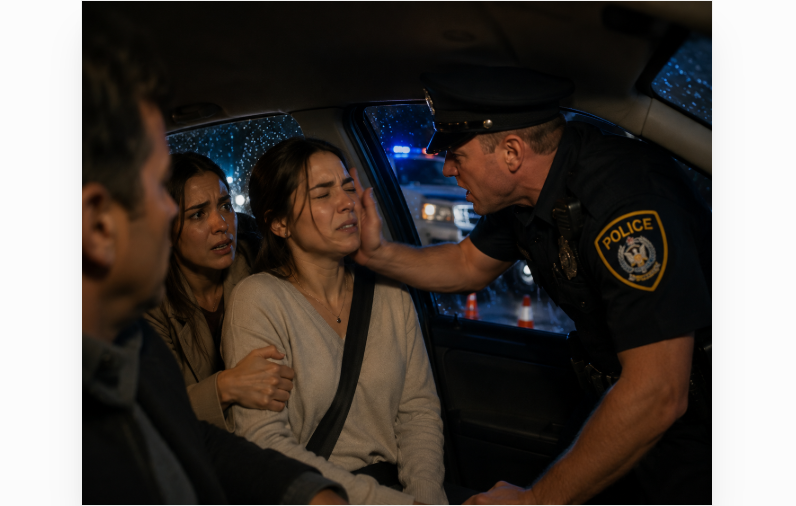
She glanced at me. “Should we be worried?”
I smiled a little. “No. We didn’t do anything.”
That should have been true.
Luis rolled the taxi forward slowly. An officer approached the driver’s window with a flashlight in one hand and irritation already written across his face. He was tall, broad, maybe late thirties, with the kind of posture that said he expected people to obey before he even spoke.
“License,” he snapped.
Luis handed it over quickly.
The officer looked at it, then at him. “Where are you headed?”
“Upper West Side,” Luis said.
“From where?”
“The Village.”
The officer shined the flashlight into the back seat.
The beam hit my face first, then Naomi’s. She blinked and turned away. I raised my hand slightly to block the light.
“Keep your hands where I can see them,” the officer barked.
I lowered my hand slowly. “Officer, the light is in my eyes.”
He stared at me.
Something in his expression changed. Not concern. Not professionalism. Annoyance.
“You got something to say?”
“No,” I replied calmly. “I’m just asking you not to shine it directly into my eyes.”
Naomi shifted beside me. I felt her go tense.
The officer leaned closer through the open driver’s window. “You been drinking?”
I had not.
“We had dinner,” I said. “I’m not driving.”
“I asked if you were drinking.”
“I heard you.”
Luis went very still.
The officer’s jaw tightened. “Step out of the vehicle.”
I looked at him carefully. “On what grounds?”
That was the moment his pride took control of him.
He yanked open the back door so hard the taxi rocked. Rain blew in. Naomi gasped.
“I said step out.”
I stayed seated. “Officer, I’m asking for your name and badge number.”
His face darkened.
Naomi reached for her phone.
The officer noticed.
“Put that down.”
“She has a right to record,” I said.
He looked at me like I had personally insulted him.
“Lady, you don’t tell me what rights are.”
That sentence still rings in my head.
Because I did know.
I had spent twelve years in law enforcement. I had worked internal investigations. I had sat across from officers who thought the uniform made them untouchable. I had seen good cops ruined by bad ones, and I had seen bad ones protected because nobody wanted the embarrassment.
That night, I was not wearing my badge.
But I still knew exactly what he was doing.
“I’m asking you again,” I said, keeping my voice steady. “Please identify yourself.”
The slap came before I finished the sentence.
His hand struck the left side of my face so hard my head snapped sideways. For one second, the entire world went quiet. Not because there was no sound, but because shock swallowed all of it.
Naomi screamed my name.
Luis shouted, “Hey!”
The officer pointed at me. “That’s what happens when you act smart.”
My cheek burned. My ear rang. My hands shook, but I did not cry.
I looked at him.
Really looked at him.
He still thought I was afraid.
He still thought he had control.
That was his mistake.
I slowly turned to Naomi. “Are you recording?”
Her face was pale. Her phone was in her lap, camera still pointed toward the door.
“Yes,” she whispered.
The officer’s expression changed.
Just a flicker.
But I saw it.
He reached for the phone. “Give me that.”
I moved before he could touch her. “Do not put your hands on my sister.”
He stepped closer.
Then another officer approached from behind him. “Brennan, what’s going on?”
Brennan.
Now I had a name.
Officer Brennan glanced back and said, “Passenger became aggressive.”
Naomi made a sound of disbelief. “He hit her!”
The second officer looked at me, then at Brennan, then at Naomi’s phone.
I said nothing.
Not because I had nothing to say.
Because I knew the value of silence when someone else was digging their own grave.
The second officer told Brennan to step away from the taxi. Brennan hesitated, then slammed the door shut. He kept my ID for nearly ten minutes, probably hoping I would start yelling, hoping I would give him something to use.
I didn’t.
When he finally returned it, he refused to look at me.
“Go,” he told Luis.
Luis pulled away from the checkpoint with trembling hands.
Nobody spoke for two blocks.
Then Naomi burst into tears.
“I’m sorry,” she said. “I should have done something.”
I touched my cheek. It was already swelling.
“You did,” I said. “You recorded.”
When we got back to my apartment, I locked the door, sat at my kitchen table, and watched the video three times. Each time, I felt colder. Not because of the slap. Because of how easily it had happened.
How casual he was.
How certain he was that nothing would happen to him.
Naomi sat across from me, arms folded tight. “What are you going to do?”
I didn’t answer right away.
I opened my laptop.
Then I made one quiet phone call.
The man who answered was Deputy Commissioner Warren Ellis.
He knew my voice immediately.
“Captain Reed?”
“Sorry to call late,” I said.
He paused. “What happened?”
I sent him the video.
There was silence on the line while he watched it.
Then he said one word.
“Jesus.”
By 8:00 the next morning, I was in a conference room with Internal Affairs.
By 9:30, they had the taxi driver’s statement.
By 10:15, they had Naomi’s full recording, the checkpoint body cam logs, and dispatch records.
By noon, Officer Brennan had been placed on administrative leave.
By three, three other officers from that checkpoint had been interviewed, including the one who heard Naomi say, “He hit her,” and watched Brennan lie.
But the story did not stop there.
Because once Brennan’s name came up, so did others.
A waitress who said he shoved her during a noise complaint.
A college student who said he threatened to arrest him for filming.
A delivery driver who claimed Brennan broke his phone during a stop.
A woman from Queens who filed a complaint two years earlier after he grabbed her arm hard enough to leave bruises.
Every complaint had been dismissed.
Every one.
The department called them “unsubstantiated.”
But now there was video.
And now there was me.
A week later, I sat across from Brennan in an administrative hearing. He looked different without the street, the lights, the rain, and the taxi door between us. Smaller somehow. Angry, but scared.
His lawyer tried to say I had been confrontational.
I said, “Asking for a badge number is not confrontation.”
They tried to say I had escalated the situation.
I said, “He opened the door.”
They tried to say the slap was not visible clearly enough.
Naomi’s video was played again.
The sound of his hand hitting my face filled the room.
Nobody spoke after that.
Brennan did not apologize.
Not once.
That told me everything I needed to know.
He was fired three months later.
The taxi driver received a formal apology from the department after they reviewed how Brennan had treated him before turning his attention to us. Naomi started volunteering with a legal advocacy group. And me? I returned to work with a bruise that faded long before the anger did.
But I kept one screenshot from the video.
Not of the slap.
Not of Brennan’s face.
Of the exact second before it happened.
The moment he looked at me and decided I was powerless.
That was the part I never wanted to forget.
Because power reveals people.
So does the assumption that nobody important is watching.
And the truth is, he was wrong from the beginning.
I wasn’t important because I had a badge.
I wasn’t important because I knew the deputy commissioner.
I wasn’t important because I could make a phone call.
I was important before he knew any of that.
I was important when I was just a woman in the back of a taxi, coming home in the rain with my sister.
That was the lesson he never learned.
But it was the one that finally ended him.


