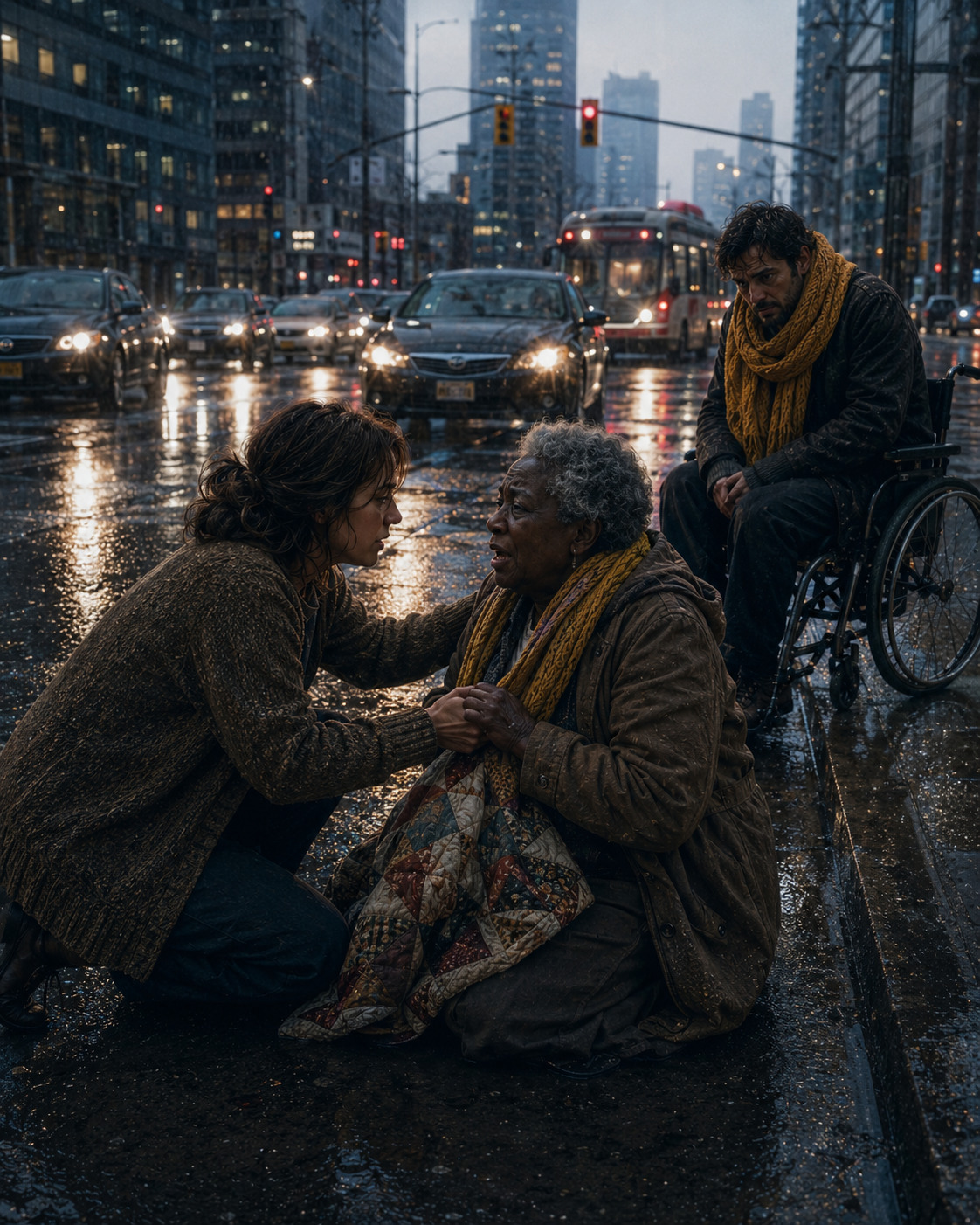
The first time I saw Nathaniel, he was sitting alone in a wheelchair beneath the awning of a closed hardware store while November rain swept sideways across Queen Street. He looked cold enough to disappear into the dark, his hands shaking inside fingerless gloves, his coat too thin for the weather. I had just finished another brutal shift at Riverside Family Shelter, where I had been forced to tell a mother and her two children that we had no beds left, and I did not have enough strength to carry one more person’s pain. Still, when I saw him shivering, I removed the mustard-colored scarf from my neck and wrapped it around his shoulders. He stared at me as if kindness were something dangerous. Then he pulled a notebook from his jacket and wrote, “Thank you.” I introduced myself as Margaret Whitcomb and told him I worked at the shelter. He never spoke, only listened with those quiet, wounded eyes. I believed he was homeless, unable to walk, and possibly unable to speak. I had no idea that the man beneath that scarf was Marshall Renwick, one of the city’s most feared billionaires, hiding from the people who had tried to kill him.

A week later, I saw him again in Trinity Bellwoods Park. I was struggling with an sign-language app because several children at the shelter were deaf, and I wanted to communicate with them properly. Nathaniel signed fluently, faster and more naturally than anyone I had ever met, then agreed to teach me in exchange for coffee. Over the following months, our evening video calls became the safest part of my life. He signed about birds, documentaries, and the cold streets he supposedly slept on, while I told him about the people at the shelter, the donors who disappeared, and the exhausting work of caring for people the city had forgotten. By winter, I was pushing his wheelchair through High Park every Sunday. One afternoon, I stepped onto the footrests and tried to spin us both in the snow. The chair caught in a rut, and before we could fall, his arm locked around my waist with shocking strength. He pulled us back upright in one controlled movement, then immediately pretended the effort had exhausted him. I asked why he was so strong, but he lowered his eyes and let his hands tremble. I wanted to believe him, so I did.

The truth began to show itself slowly. A black vehicle sometimes waited across the street. Nathaniel watched windows and exits like a man expecting danger. One evening, while he slept on my couch, a small earpiece slipped from his ear. A voice came through it, speaking about corporate transfers, hostile factions, and someone calling him “sir.” He woke instantly and snatched it away with the reflexes of someone trained to survive. When I questioned him, he claimed it was a business podcast. I knew he was lying, but I did not yet understand how large the lie was. Three weeks later, the company known as the Glass Wolf acquired the parent charity that owned Riverside Family Shelter. We were told half the staff would be dismissed. I spent three sleepless nights preparing a presentation about every person the shelter had helped, convinced that if I could reach the mysterious CEO, I might save the place.
The meeting was held eighty-one floors above Bay Street. I walked into an office of glass and steel, gripped my portfolio, and told the man facing the window that he could buy our building, our budget, and our beds, but he could not decide that people were worthless because they did not fit neatly on a balance sheet. Then the chair turned.
Nathaniel stood.
Not Nathaniel, I realized.
Marshall Renwick.
He was wearing a charcoal suit, standing on two perfectly strong legs, and speaking in a deep voice I had never heard. The portfolio fell from my hands. “You can walk,” I whispered. “You can speak.” He told me that his own board had arranged an attempt on his life fourteen months earlier, so he had faked paralysis and silence while secretly investigating those responsible. The black vehicles had been searching for him. He claimed he came out of hiding because his company had purchased my shelter, and he could not allow it to be destroyed. He expected me to understand that fear had forced him to lie. Instead, I felt sick. He had used my home, my trust, and my love as camouflage. Every vulnerable moment I had shared suddenly felt stolen. I slapped him, removed the cheap silver ring he had once given me, and threw it across the marble floor. “You are not poor,” I told him. “You are bankrupt where it matters. You borrowed my honesty to hide your cowardice.”

I disappeared from his life the next morning. I resigned from Riverside, changed my number, and accepted a low-paying position at a seniors’ day program in the East End. I told myself I was not heartbroken because he was wealthy; I was heartbroken because he had looked directly at me for a year and decided I was not worthy of the truth. Marshall did not chase me. He did not arrive with flowers or make public apologies. Instead, he destroyed the network of executives who had ordered the attempt on his life, removed every person who had made hiding necessary, and then quietly began helping the people I cared about. New wheelchairs arrived at the day program. Hearing devices were donated. An accessible van appeared without a donor’s name attached. I knew it was him, but he never asked for gratitude.
Months later, on the first warm day of spring, an old school bus stopped outside the day program. Marshall stepped down wearing jeans and a plain gray sweater, carrying a bag of yarn. He walked past me and sat beside Mrs. Okonkwo Hale, an elderly woman I had once helped through a panic attack in traffic. Then he began trying to knit. His hands were terrible at it. I crossed the garden ready to order him away, but when I saw him patiently signing to her between clumsy stitches, my anger weakened just enough for me to listen.

“What are you doing here?” I asked.
He looked up and said, “I did not come as a CEO. I came to pay my tuition.”
Then he pulled my old mustard-colored scarf from the bag. It was more frayed now, but he had kept it. “You taught me how to listen with my eyes,” he said. “I want to learn how to love without hiding. No boardrooms, no wheelchairs, no borrowed weakness.”
I wanted to be furious. Part of me still was. But he did not ask me to forgive him immediately, and he did not promise that one grand gesture could erase a year of deception. He simply placed the knitting needles in his hands and waited.
“Stop making speeches,” I told him. “Finish the row.”
He tried. He failed. I sat beside him and placed my hands over his, guiding the yarn one slow stitch at a time. Above us, white blossoms drifted through the spring air and settled across the scarf lying on the bench. It was no longer armor against the cold. It had become something else, a thread that had survived every lie, every wound, and every mile between who we had been and who we were still trying to become.