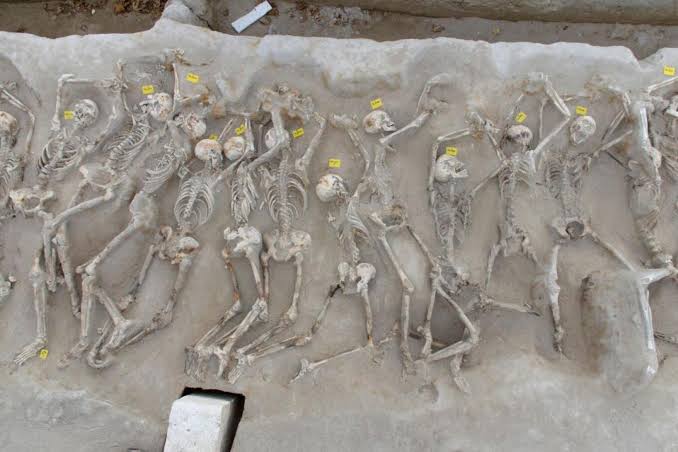
Beneath the modern southern coastline of Athens, archaeologists encountered one of the most haunting burial discoveries associated with ancient Greece. At Phaleron, the port used by Athens before the rise of Piraeus, excavators uncovered a group of approximately 80 male skeletons placed side by side in mass graves. Their orderly arrangement was disturbing enough, but the presence of iron restraints transformed the discovery into evidence of a possible mass execution. Thirty-six of the men were reportedly still shackled, while many had been positioned with their restrained arms raised above their heads.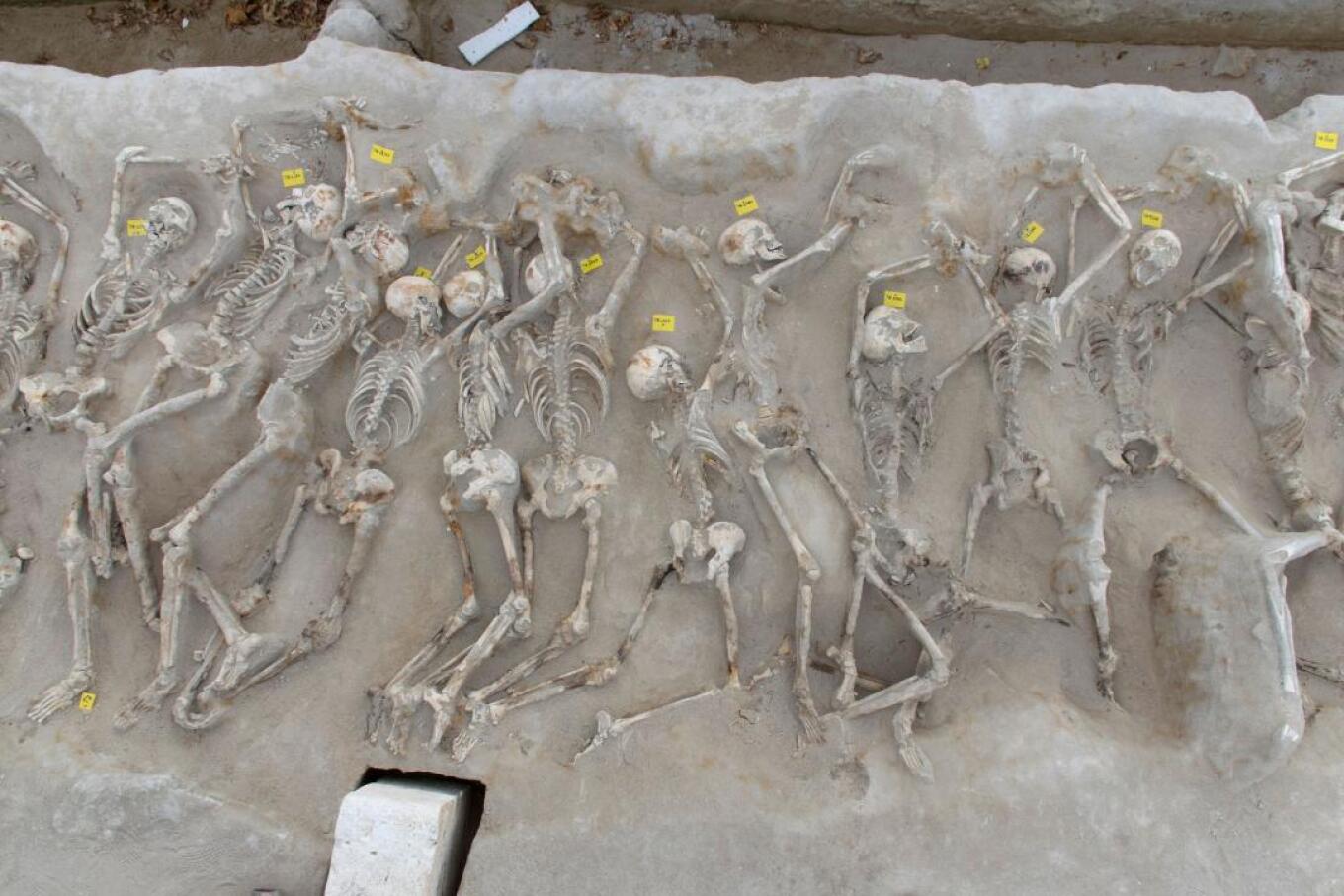
The remains were found within the large cemetery of the Faliron Delta, an archaeological landscape containing around 1,500 burials from different periods. The group attracted international attention in 2016, when details of the unusual burial became widely known during work connected with the Stavros Niarchos Foundation Cultural Center, near the sites of the Greek National Opera and National Library.
The men were buried in rows rather than thrown together carelessly. Some lay on their backs, while others were positioned face down. Iron restraints remained around the wrists of many individuals, and at least one body reportedly showed evidence that the legs had also been tied. The positioning of the arms above the head remains especially puzzling because captives are more commonly imagined with their hands secured behind their backs.
Examination of the skeletons suggested that many of the dead were young men who had been in relatively good health before their deaths. Their teeth were generally well preserved, and the bodies did not display the patterns expected from a population weakened by prolonged illness or famine. This strengthened the theory that they were prisoners or political captives killed during a single violent event.
The graves have been dated broadly to the 7th century BC, with some reports placing the burial around 650–625 BC. This was a turbulent period in the history of Athens, long before the city became famous for democracy, philosophy, and its Classical monuments. Power was concentrated among aristocratic families, and political disputes could end in exile, betrayal, or execution.
One historical episode has repeatedly been proposed as a possible explanation: the attempted coup of Cylon. Cylon was an Athenian nobleman and celebrated athlete who tried to seize control of Athens during the 7th century BC. Ancient accounts describe how he and his supporters occupied the Acropolis but were surrounded when the attempt failed.
Cylon escaped, but many of his followers sought protection at a sacred place, reportedly believing that religious sanctuary would spare them. According to later traditions, they were persuaded to leave and were then killed. The incident became notorious because their execution was seen as a violation of sacred protection and was remembered as a stain upon the powerful Alcmaeonid family.
Because the Phaleron prisoners lived during approximately the same historical period, some archaeologists have wondered whether the shackled men could have been supporters of Cylon. The possibility is compelling: a failed political uprising, captured young men, a collective execution, and a burial outside the center of Athens. Yet the connection remains a hypothesis rather than an established identification. No surviving inscription names the dead, and the archaeological dating is not precise enough by itself to prove that they belonged to Cylon’s rebellion.
Other explanations remain possible. The men could have been pirates, enslaved captives, foreign enemies, condemned criminals, or participants in another political conflict no longer recorded in surviving texts. Ancient written history preserves only fragments of the violence that shaped early Athens, and many executions would never have been described by later historians.
The orderly character of the burial raises additional questions. Although the men appear to have suffered violent restraint, their bodies were not simply abandoned. Someone placed them in rows and covered them with earth. That organization suggests an official or controlled event, possibly carried out by authorities rather than an uncontrolled massacre.
The shackles themselves are among the most important pieces of evidence. Iron restraints were costly objects and would not necessarily have been left with the dead without reason. Their presence may indicate that the bodies were buried quickly, that removing the restraints was considered unnecessary, or that the shackles were intentionally retained to mark the status of the victims even in death.
The position of their arms may also preserve information about the execution. They could have been tied before being forced into the grave, restrained during transport, or arranged after death. Archaeologists must study joint positions, iron corrosion, soil movement, and skeletal damage to reconstruct the sequence accurately. What appears dramatic in photographs may have been altered slightly by pressure and decomposition over centuries.
Modern scientific analysis offers several possible paths toward understanding the group. DNA studies may reveal whether the men were biologically related. Isotope analysis of teeth and bones can indicate whether they grew up in Athens or came from distant regions. Evidence of trauma may help determine how they died, while nutrition and disease patterns could clarify their social background.
If many were nonlocal, the prisoners may have been foreign fighters or captives. If they shared family relationships, they might have belonged to the same political or social faction. If they were local but unrelated, the grave could represent a broader purge involving young men from different Athenian households.
The Phaleron cemetery is valuable because it preserves the lives of people often absent from ancient literature. Classical texts usually focus on rulers, generals, lawmakers, and elite families. Cemeteries reveal a wider society that included laborers, children, prisoners, foreigners, and people who died without leaving their names in written history.
The shackled men occupy an uncomfortable space between archaeology and political memory. They lived before the democratic Athens celebrated by later generations. Their grave is a reminder that the city’s political development was not peaceful or inevitable. It emerged from generations of aristocratic rivalry, social instability, attempted seizures of power, and acts of violence.
As conservation and research continue, the skeletons may eventually reveal more about their origins and deaths. Yet even advanced science may never attach individual names to them or identify the command that condemned them.
What remains certain is the scene preserved beneath the soil: dozens of young men, aligned in rows, many still carrying iron restraints. They were buried together during a dangerous chapter of early Athenian history, leaving behind no written testimony.
Their shackles survived when their voices did not. More than 2,600 years later, the silent dead of Phaleron continue to ask the same question: who feared them enough to bind and execute them—and why?