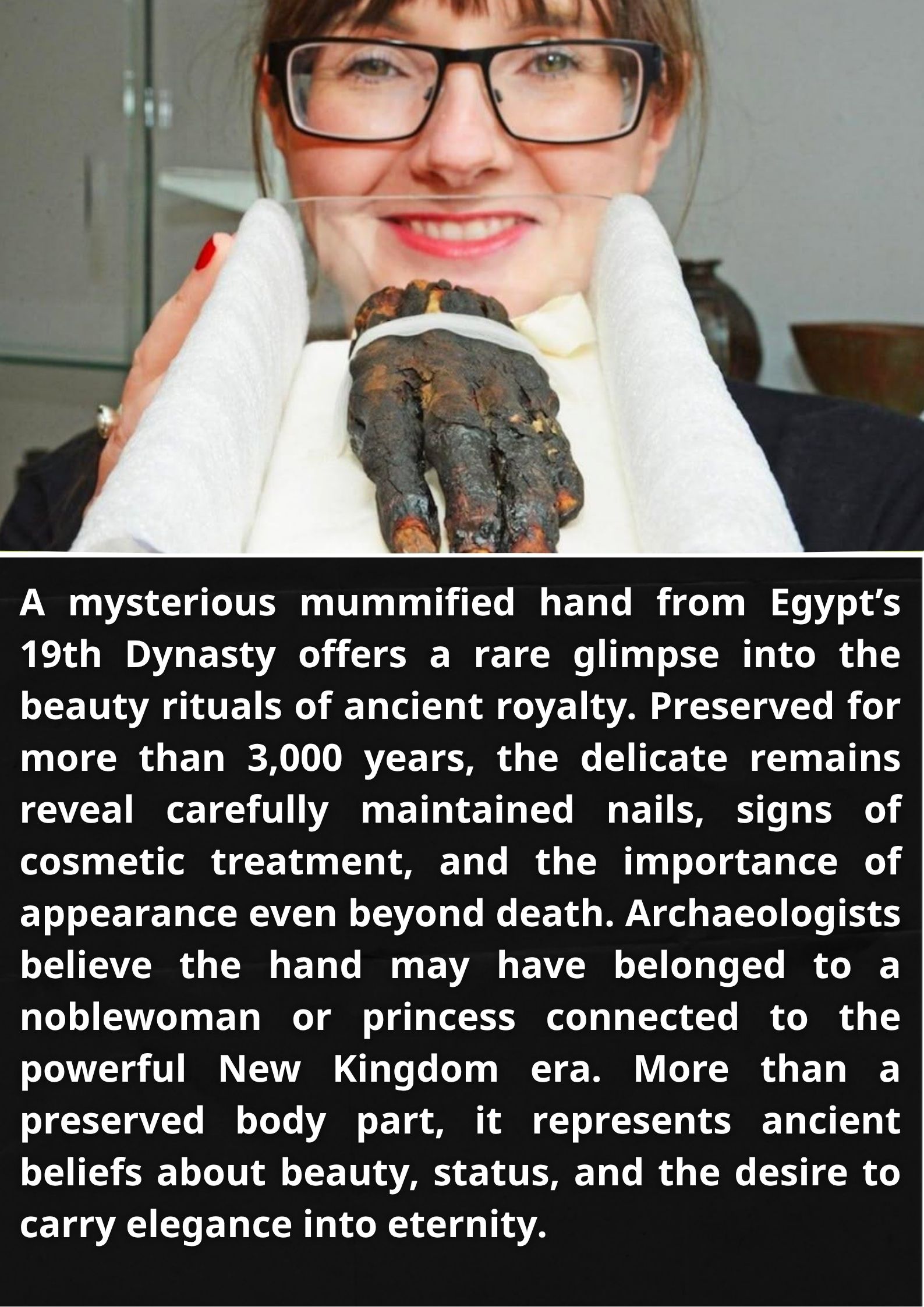
For thousands of years, ancient Egyptian civilization has fascinated the world with its pyramids, temples, royal tombs, and extraordinary mummification traditions. But sometimes, the smallest discoveries can reveal the most intimate stories about the past. Among these remarkable finds is a mummified hand believed to belong to a royal woman from Egypt’s 19th Dynasty—a preserved fragment that offers a rare glimpse into the beauty practices, social status, and beliefs surrounding death in ancient Egypt.
The 19th Dynasty, which ruled Egypt during the New Kingdom period, was one of the most powerful eras in Egyptian history. Dating approximately from 1292 to 1189 BCE, this period included famous rulers such as Seti I and Ramesses II. It was an age of military expansion, monumental construction, artistic achievement, and elaborate royal traditions.
For Egyptian elites, appearance was deeply connected to identity and social position. Beauty was not considered merely a physical quality. It reflected purity, health, wealth, and divine order. Royal women, especially princesses and members of noble families, followed carefully developed beauty routines that involved cosmetics, perfumes, jewelry, hairstyles, and skin treatments.
The preserved hand provides archaeologists with an unusual opportunity to study these traditions through physical evidence rather than written descriptions alone.
Unlike complete mummies, isolated body parts can sometimes reveal specific details that might be overlooked during larger examinations. The condition of the nails, skin, and tissues can provide clues about age, health, preparation methods, and even cultural practices.
Researchers examining the mummified hand noticed signs of careful preservation and attention to detail. The nails appear to have been maintained, suggesting that the individual was not someone of ordinary status. In ancient Egypt, hands and nails could symbolize refinement and elegance, particularly among wealthy women who had access to specialized care.
The preservation process itself was another indication of importance. Egyptian mummification was not simply about preventing decay. It was a complex religious practice designed to protect the body for the journey into the afterlife. The Egyptians believed that preserving physical form allowed the individual’s spiritual aspects to continue existing.
For members of royalty, the process was often more elaborate. Bodies were treated with oils, resins, and aromatic substances. Internal organs were carefully handled, and layers of linen were wrapped around the body. Amulets and protective objects were sometimes placed among the wrappings to provide spiritual protection.
Even a single preserved hand could carry evidence of these practices.
Ancient Egyptian beauty rituals were highly advanced for their time. Women used mineral-based cosmetics around the eyes, including kohl made from substances such as galena. These dark pigments were not only decorative but were also believed to provide protection from the harsh desert environment and possibly from infections.
Skin care was another important aspect of daily life among the elite. Oils, perfumes, and scented ointments were used to moisturize the skin and create pleasant fragrances. Ingredients such as lotus flowers, honey, animal fats, and aromatic plants were incorporated into cosmetic preparations.
Hair was also a major symbol of beauty and status. Wealthy Egyptian women often wore carefully styled hair or elaborate wigs decorated with beads, ribbons, and jewelry. These details were carefully represented in paintings and statues, showing how strongly appearance was connected to identity.
The mummified hand offers a physical connection to these ancient ideals. It suggests that even after death, preserving beauty remained important. The individual was not simply prepared for burial but was transformed into an eternal version of herself.
This belief was central to Egyptian culture. Death was not viewed as the complete end of existence but as a transition into another realm. Maintaining the body’s appearance helped ensure that the person could continue to exist in the afterlife.
For royal women, this idea carried additional meaning. Their beauty and status were connected to their role within the royal family and the divine order of Egypt. A carefully preserved body represented not only personal identity but also the prestige of the dynasty they belonged to.
The discovery also highlights the challenges faced by modern archaeologists. Studying ancient human remains requires careful scientific methods and respect for cultural heritage. Researchers must balance the desire to learn from the past with the responsibility to preserve these remains properly.
Modern technologies, including imaging techniques and chemical analysis, allow scientists to investigate mummies without causing unnecessary damage. They can examine materials used during embalming, identify traces of cosmetics, and learn more about the lives of individuals who lived thousands of years ago.
Every discovery adds another piece to the larger story of ancient Egypt.
The mummified hand may never reveal the exact name of the woman it belonged to. Historical records from thousands of years ago are incomplete, and many royal family members remain unknown. Yet the artifact still tells a powerful story.
It reveals that beauty, identity, and memory were important concerns long before modern society. The woman who owned this hand lived in a world of temples, pharaohs, rituals, and powerful beliefs about eternity. She used the same human desire for self-expression and dignity that continues today.
A small preserved hand, hidden for more than three millennia, has become a silent messenger from the past. It reminds us that history is not only written in monuments and royal inscriptions. Sometimes, it survives in the smallest details—the shape of a nail, the trace of a cosmetic treatment, or the careful preservation of a person who hoped to remain remembered forever.
The mummified hand of this Egyptian princess or noblewoman is more than an archaeological object. It is a rare glimpse into the private world of ancient beauty, showing that even after thousands of years, the desire to preserve elegance, identity, and legacy remains timeless.