Before you judge the quiet woman standing in the corner of that Chicago kitchen, remember this: sometimes the person everyone underestimates is the only one in the room who truly understands greatness. And on the night Chef Maxwell Reed tried to embarrass a simple-looking new hire by forcing her to cook the hardest dish on his menu, he had no idea he was challenging a woman whose food had once made Paris fall silent.
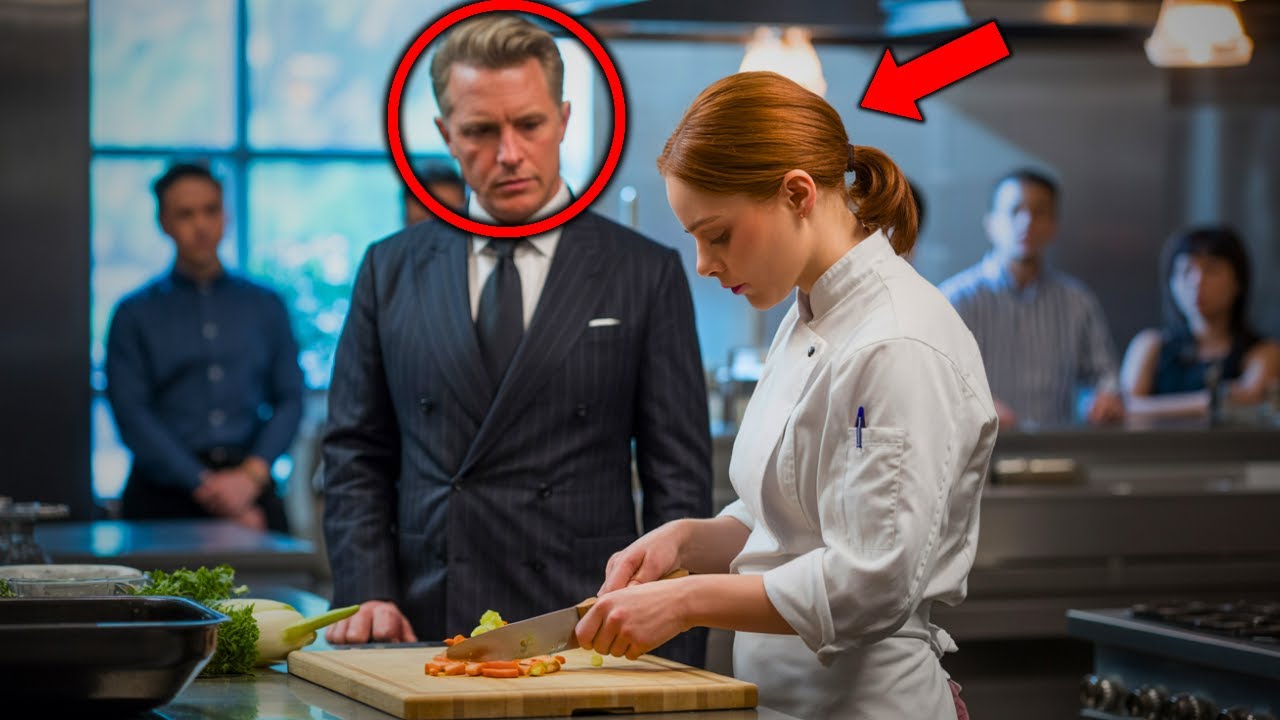
Amelia Hart arrived at Meridian, one of Chicago’s most praised restaurants, wearing plain black pants, a white shirt, and no expression that suggested importance. Her auburn hair was tied back in a loose ponytail. Her shoes were practical. Her resume was intentionally modest. To anyone watching, she looked like a woman hoping for a line cook position and maybe a second chance.
That was exactly what she wanted them to think.
Two years earlier, Amelia Hartwell had been the most talked-about chef in Europe. Her Paris restaurant, Étoile Noire, had earned three Michelin stars before her thirty-second birthday. Critics called her beef Wellington “a religious experience.” Culinary students studied her pastry work the way musicians studied Mozart. But fame had slowly turned cooking into combat. Every plate had become a test. Every review felt like a judgment on her soul. One morning, she walked into her perfect kitchen, looked at the silent fear in her team’s eyes, and realized she no longer loved the thing she had given her life to.
So she disappeared.
Now, under the shorter name Amy Hart, she was traveling through American restaurants, working quietly, researching a book about kitchens, ego, and the lost joy of feeding people.
Meridian’s executive chef, Maxwell Reed, barely looked at her when she arrived.
“French training?” he asked, scanning her resume with bored suspicion.
“A little,” Amelia said.
“Small restaurants?”
“Mostly.”
Maxwell smirked. He was tall, sharp-faced, and famous for terrifying his staff into perfection. Every cook in his kitchen moved like they were afraid the floor might explode beneath them. No one laughed. No one questioned him. No one breathed too loudly.
“We need bodies for tomorrow’s foundation dinner,” he said. “You can prep vegetables. Try not to slow anyone down.”
Amelia smiled politely. “Of course, Chef.”
For the rest of the day, she chopped, cleaned, listened, and watched. Maxwell barked at his sous-chef for plating a sauce half an inch too wide. He mocked a young cook until her hands shook over the garnish tray. He sent back a dish he had not tasted, simply because he disliked the color of the puree.
“This kitchen has standards,” he snapped at Amelia when she diced shallots faster than anyone on the line. “This isn’t some home-cooking class.”
“No, Chef,” she said calmly.
Inside, she felt something sadder than anger. The man had skill. She could see it in his sauces, his timing, his structure. But his kitchen had no warmth. It was full of precision and empty of joy.
The next evening, Meridian was chaos. The dining room was packed for a prestigious culinary foundation event. Food critics, donors, restaurant owners, and wealthy guests filled the tables. In the kitchen, pans hissed, knives flashed, and Maxwell prowled like a general waiting for one soldier to fail.
Then a server rushed in.
“Chef, VIP table wants the beef Wellington.”
The room tightened.
Everyone knew the Wellington was Maxwell’s pride. He never let anyone else prepare it. It was technical, unforgiving, and famous enough that critics mentioned it in reviews.
Maxwell’s eyes moved across the kitchen and stopped on Amelia.
“You,” he said.
She looked up from the herbs she was trimming.
“Me, Chef?”
“You said you had French training.” His smile was cold. “Make the Wellington.”
The kitchen went silent.
A young line cook looked down. The sous-chef, Daniel, whispered as he passed, “He’s setting you up. Nobody touches that dish.”
Amelia glanced at Maxwell’s recipe. It was good. Technically correct. But stiff. Safe. The kind of recipe built to impress instead of move someone.
“I’ve never made your version,” she said.
“Then learn fast,” Maxwell replied. “If it fails, you’re done here.”
A few cooks avoided her eyes. They had seen this game before. Maxwell liked public humiliation. It reminded everyone who controlled the room.
Amelia tied her apron tighter.
For the first time since she entered Meridian, her posture changed.
Not dramatically. Not enough for everyone to understand at once. But Daniel noticed. Her hands stopped moving like a prep cook’s. They became faster, quieter, certain. She touched the tenderloin and seemed to read it like a musician reading sheet music. She examined the mushrooms, the pastry, the stock, the wine. Then she began.
Maxwell hovered. “Chop the mushrooms finer.”
Amelia continued.
“That’s too much heat on the pan.”
“It needs twenty more seconds,” she said softly, “or the crust won’t develop properly.”
Maxwell blinked.
The answer had been calm, precise, and correct.
She added shallots cooked to the edge of sweetness, thyme crushed between her fingers, a splash of Madeira, and a breath of cognac that flared blue over the pan. The aroma changed the kitchen. Cooks began slowing down when they passed her station.
“That’s not my recipe,” Maxwell said sharply.
“No,” Amelia replied. “It’s what the beef asked for.”
Someone nearly laughed, then caught themselves.
Maxwell’s jaw tightened. “The beef asked?”
“Ingredients speak,” she said. “We’re supposed to listen.”
Now everyone was watching.
She wrapped the tenderloin with impossible clean layers, sealed the pastry without a wrinkle, and cut a delicate lattice across the top so precise it looked painted. When she placed it in the oven, Maxwell pointed at the clock.
“Forty-two minutes.”
“Thirty-eight,” she said.
“You don’t know that.”
“I do.”
He stared at her. For the first time all night, uncertainty flickered in his eyes.
While the Wellington baked, Amelia made a sauce so glossy it caught the overhead light. She roasted carrots until their edges caramelized, then balanced them with lemon and herbs. She never rushed. She never panicked. The entire kitchen seemed to breathe with her.
At thirty-seven minutes, she walked to the oven.
Maxwell snapped, “It isn’t ready.”
Amelia turned to him, and the gentle mask finally dropped.
“The pastry is at peak color. The beef will be 128 degrees in the center and finish at 132 while resting. If I wait for your timer, the pastry fat will over-render and the tenderloin will lose its bloom.”
The kitchen went dead silent.
No prep cook spoke like that.
No nervous applicant corrected Chef Maxwell Reed in front of his staff.
She opened the oven.
The Wellington emerged golden, structured, perfect.
Daniel whispered, “Who are you?”
Maxwell had already pulled out his phone. His face was losing color as he searched, scrolled, stopped, and looked up.
“Your name isn’t Amy Hart,” he said slowly.
Amelia rested the Wellington on the counter. “Amy is my middle name.”
“You’re Amelia Hartwell.”
A gasp moved through the kitchen.
One cook dropped a spoon.
Daniel looked like he had seen a ghost. “From Étoile Noire?”
Amelia smiled faintly. “Formerly.”
Maxwell’s face twisted with humiliation. “You came here to mock me?”
“No,” she said. “I came here to understand why so many talented kitchens feel miserable.”
The words landed harder than any insult.
Daniel sliced the Wellington. The cross-section was flawless: crisp pastry, dark mushroom layer, tenderloin glowing perfect pink. Even Maxwell could not pretend otherwise.
A server carried the plate out.
Minutes later, applause rose from the dining room.
Then the dining room manager burst through the doors. “The VIP table says it’s the best Wellington they’ve ever had. They want to meet the chef.”
Everyone looked at Maxwell.
For one long moment, his pride battled his conscience.
Then, quietly, he said, “Chef Hartwell made it.”
Amelia studied him. There it was—the first honest thing she had seen him do.
She turned to the manager. “Tell them it came from Chef Reed’s kitchen and his team.”
Maxwell stared at her. “Why would you give me credit?”
“I’m not,” she said. “I’m giving the kitchen credit. That’s what leaders are supposed to do.”
Something in his face shifted.
The anger did not vanish, but it cracked. Beneath it was exhaustion. Fear. Maybe even shame.
Later, after service slowed, Maxwell stood beside her station.
“You said my food has no heart.”
“I said your kitchen has forgotten joy.”
He looked around. His cooks quickly lowered their eyes. For the first time, he seemed to notice they were afraid of him.
“I built this place from nothing,” he said.
“I believe you.”
“I thought if I softened, standards would fall.”
Amelia shook her head. “Fear can create obedience. It cannot create greatness.”
He looked at the Wellington recipe card still lying on the counter. “Would you show me the mushroom technique?”
The question was quiet.
Humble.
The entire kitchen heard it.
And just like that, the air changed.
Over the next two weeks, Amelia stayed at Meridian. She taught, observed, and listened. Maxwell did not transform overnight, but he began trying. He corrected without cruelty. He asked cooks what they thought. He let Daniel plate a dish without changing it at the last second. One night, someone laughed during service—and no one was punished for it.
On Amelia’s final evening, the staff gathered for pre-service. The special was a new Wellington, built from Maxwell’s structure and Amelia’s soul. His precision. Her warmth. Their collaboration.
Maxwell handed her a notebook.
“I wrote down what I learned,” he said.
Amelia opened it. The first line read: A kitchen is not a battlefield. It is a place where hunger meets care.
She smiled.
“You remembered.”
“No,” he said. “I finally understood.”
As Amelia walked out through the back door into the cold Chicago night, she heard something behind her that had been missing when she arrived.
Maxwell laughing with his team.
Not loudly. Not perfectly.
But honestly.
And that was enough.
Because the greatest chefs do not simply master fire, knives, and timing. They master the humility to remember that food is not made to prove power. It is made to give something human back to the world.
So tell me—have you ever seen someone underestimated, only for them to reveal extraordinary talent at the perfect moment? Share your thoughts in the comments, and follow for more emotional stories where the quietest person in the room changes everything.