At the beginning of the twentieth century, New York City was rapidly becoming a global center of finance, industry, culture, and extraordinary private wealth. Among the powerful figures who helped shape that era, few names carried more influence than John Pierpont Morgan. Known simply as J. P. Morgan, he was a banker whose decisions could move markets, rescue struggling companies, and affect the direction of the American economy. Yet behind the imposing public figure was another side of Morgan—a passionate collector fascinated by rare books, manuscripts, art, and objects that carried the memory of past civilizations.
Morgan did not view books merely as objects to be read. To him, a rare book was a physical connection to history. The paper, ink, binding, handwriting, and signs of age all told a story that no modern reproduction could fully preserve. He wanted to hold the same pages that scholars, writers, printers, and noble families had touched centuries earlier. As his wealth increased, so did the scale and ambition of his collection.
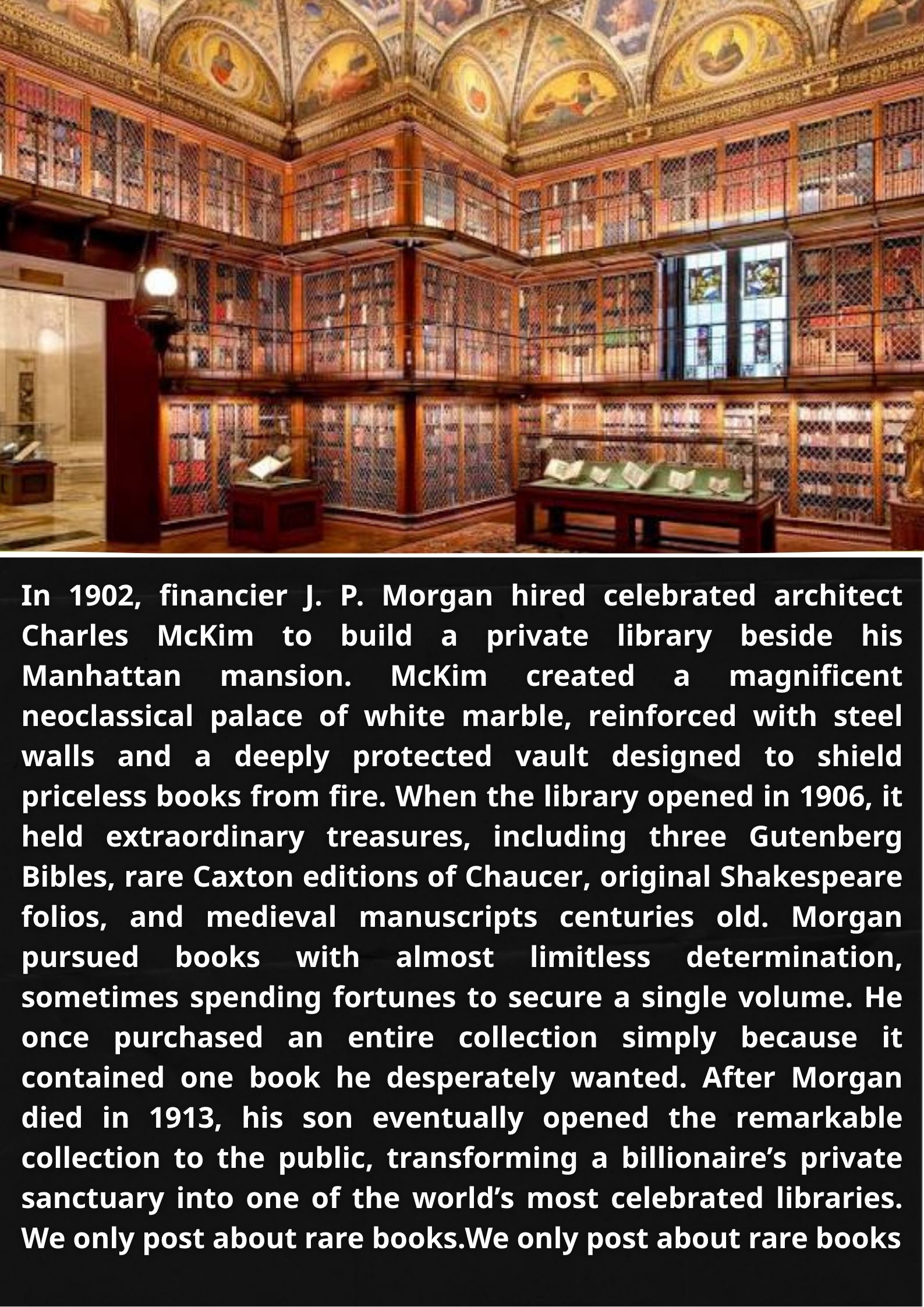
By 1902, Morgan possessed so many important books and manuscripts that an ordinary room was no longer sufficient. He decided to build a private library beside his residence on Madison Avenue in Manhattan. For the project, he selected Charles Follen McKim, one of the most respected American architects of the period and a leading figure in the firm McKim, Mead & White. The firm was associated with some of the most significant buildings in the country, including the original Pennsylvania Station.
Morgan did not ask McKim to design a simple place filled with shelves. He wanted a monument to knowledge—a building that would reflect the dignity, permanence, and grandeur of the treasures stored inside it. McKim responded with an elegant neoclassical structure inspired by the architecture of the Italian Renaissance. Its exterior was built from pale marble, while its interiors featured richly decorated ceilings, carved woodwork, elaborate bookcases, and paintings influenced by European artistic traditions.
The most famous room was Morgan’s private study, sometimes called the West Room. Dark red walls, antique furnishings, precious artworks, and shelves of carefully selected books surrounded the enormous desk where Morgan conducted both personal and professional business. The room felt less like an office and more like the private chamber of a Renaissance prince. Visitors entering it were immediately reminded that Morgan’s power extended beyond banking into the worlds of art, culture, and history.
But beauty alone was not enough. Morgan understood that fire was one of the greatest dangers facing any collection of books. New York had experienced devastating fires, and many irreplaceable libraries throughout history had been destroyed within hours. To protect his collection, the building incorporated unusually strong security measures. Steel was used within the structure, and a heavily protected vault was installed for the most valuable objects. The library was designed not only to display treasures but also to defend them.
When the building was completed in 1906, it contained a collection that rivaled those of major institutions. Among Morgan’s most celebrated possessions were three copies of the Gutenberg Bible, one of the earliest major books printed in Europe using movable metal type. Produced during the fifteenth century, the Gutenberg Bible represented a turning point in human history because printing allowed knowledge to be reproduced and distributed on a scale previously impossible.
Morgan also collected works connected to William Caxton, the first person to establish a printing press in England. These included rare editions of Geoffrey Chaucer, whose Canterbury Tales became one of the foundational works of English literature. Owning such books was not simply a matter of possessing valuable antiques. They represented decisive moments in the development of language, printing, and storytelling.
His shelves also held early editions and folios associated with William Shakespeare, illuminated manuscripts decorated by hand, historical letters, musical scores, and medieval texts created long before the invention of modern printing. Some manuscripts were older than many famous museums and institutions. Each object had survived wars, fires, political revolutions, neglect, and the slow damage of time before arriving in Morgan’s protected rooms.
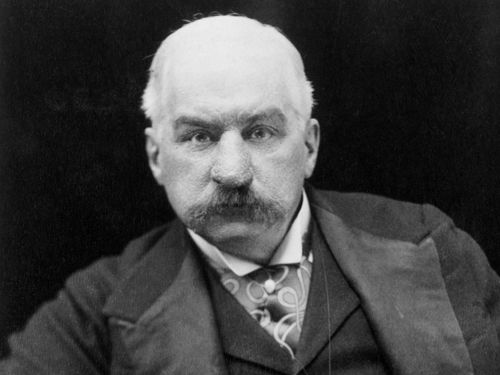 Morgan pursued these treasures with relentless determination. Dealers throughout Europe and America knew that he was willing to pay extraordinary sums for items he considered important. Wealthy collectors competed with him, while booksellers searched estates, monasteries, private collections, and auctions for objects that might capture his attention.
One story came to symbolize the intensity of his collecting. Morgan reportedly purchased an entire library because he wanted a single volume contained within it. For most people, such a decision would have been unimaginable. For Morgan, however, the value of the desired book outweighed the cost and inconvenience of acquiring everything around it. The incident revealed both the enormous resources available to him and the almost obsessive seriousness with which he approached collecting.
Yet Morgan’s library was never merely a display of wealth. He employed experts to organize, study, and care for the collection. One of the most important was Belle da Costa Greene, who became Morgan’s personal librarian. Brilliant, knowledgeable, and highly skilled in the rare-book trade, Greene helped Morgan locate important works, negotiate purchases, and develop the library into a collection of international significance. Her judgment played a major role in shaping the institution’s future.
When J. P. Morgan died in 1913, questions arose about what would happen to the extraordinary collection he had assembled. His son, J. P. Morgan Jr., inherited responsibility for the library and its treasures. Rather than allowing the collection to remain permanently hidden as the private possession of one family, he took steps to make it accessible to a wider audience.
In 1924, the library became a public institution. Scholars, researchers, and visitors could finally enter a world that had once been reserved for Morgan and his invited guests. Over time, the institution expanded, acquiring more books, manuscripts, drawings, music, and works of art. Today, it is known as the Morgan Library & Museum.
The transformation was remarkable. A building originally created as the private sanctuary of one of America’s richest men became a place where the public could encounter some of humanity’s rarest cultural achievements. Morgan’s collecting had been driven partly by personal desire and prestige, but the final result reached far beyond him.
The marble rooms, protected vaults, and ancient volumes still tell the story of a man who believed certain objects were too important to disappear. He spent fortunes pursuing books that had survived for centuries. In doing so, he created not only a collection, but also a lasting bridge between the private passions of one collector and the shared cultural inheritance of the world.