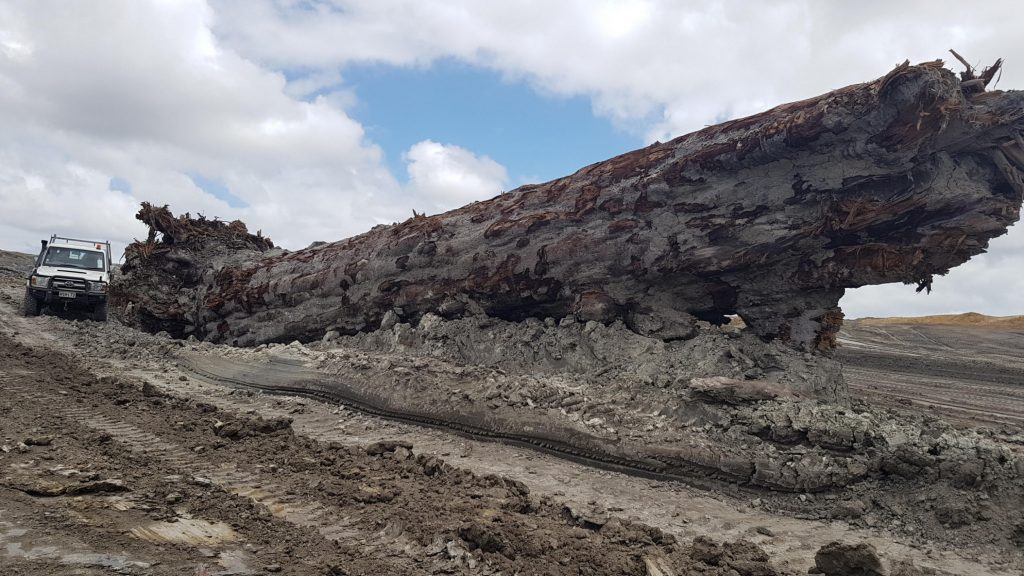
Deep beneath the ground of New Zealand’s North Island, hidden inside a peat bog for more than four millennia, scientists discovered something extraordinary: the remains of a giant ancient Kauri tree that had been preserved almost perfectly by nature.
At first glance, it appeared to be nothing more than an enormous piece of dark, weathered wood. But this massive tree trunk was far more than a prehistoric relic. It was a natural archive, a silent record of a dramatic moment in Earth’s history when the planet’s magnetic field underwent one of its strangest changes.
The ancient Kauri tree, estimated to be around 42,000 years old, lived during a period known as the Laschamps excursion. This was a time when Earth’s magnetic field weakened significantly, causing the planet’s magnetic poles to temporarily shift in position.
Unlike a complete magnetic reversal, where the north and south magnetic poles permanently swap places over thousands of years, the Laschamps event was a temporary disruption. The magnetic field became much weaker before eventually recovering and returning to a more stable state.
For modern scientists, this event is incredibly important because it provides clues about how Earth’s protective magnetic shield behaves during periods of change. But information about such ancient events is difficult to find. That is where the Kauri tree became invaluable.
Trees are natural historians. Every year, they add a new layer of growth called a tree ring. These rings preserve information about environmental conditions, climate changes, and atmospheric chemistry. Because the Kauri tree remained trapped in a peat bog, its wood avoided normal decomposition and preserved thousands of years of environmental records.
When researchers analyzed the ancient trunk, they discovered that it contained evidence of changes in atmospheric carbon-14 levels during the Laschamps excursion. As Earth’s magnetic field weakened, more cosmic radiation reached the atmosphere, affecting the production of certain radioactive elements.
The tree absorbed these changes through carbon dioxide during photosynthesis. In other words, the tree recorded the invisible changes happening above the planet while it was still alive.
A tree standing silently in an ancient New Zealand forest became a witness to a global event happening across the entire Earth.
The discovery also highlights the extraordinary preservation abilities of peat bogs. These wet, acidic environments can slow decomposition by limiting oxygen and preventing many organisms from breaking down organic material. Over thousands of years, wood, plants, and even animal remains can become naturally preserved.
The Kauri trunk survived not because it was stronger than other trees, but because it was placed in an environment that protected it from time itself.
When scientists and researchers uncovered the enormous timber, they were confronted with something almost unimaginable. A tree that had grown tens of thousands of years ago was still physically present, allowing modern humans to study a world that existed long before written history.
The scale of the discovery adds to its impact. The ancient trunk was so large that a person standing beside it appeared tiny, creating a powerful image of the difference between human lifespans and the age of the planet.
A human life lasts decades. A civilization lasts thousands of years. But this tree existed across geological time.
When it began growing, humans were still living during the late Ice Age. Massive glaciers covered parts of the planet, prehistoric animals dominated many regions, and human societies were organized very differently from today.
The Kauri tree witnessed environmental changes that humans could only reconstruct through fossils and geological evidence. It existed before agriculture spread widely, before cities appeared, and before recorded history began.
Yet through its preserved rings, it continued telling its story.
The Laschamps excursion itself remains one of the most fascinating events in Earth science. The magnetic field is generated deep within the planet by the movement of molten iron in Earth’s outer core. Although it is usually stable, it can weaken and shift over long periods of time.
Scientists study past magnetic changes because they help explain how Earth’s magnetic shield responds to internal forces. The magnetic field protects life by reducing exposure to harmful solar particles and cosmic radiation. Understanding its behavior in the past helps researchers better understand possible changes in the future.
The Kauri tree provided an unusually detailed timeline of this ancient disruption. It allowed scientists to connect tree-ring evidence with other records from ice cores, sediments, and geological samples around the world.
This type of research demonstrates how different parts of nature work together as historical records. A tree, an ice sheet, or a layer of ocean sediment can each preserve pieces of Earth’s story.
The ancient Kauri discovery also changed how researchers viewed the Laschamps event. Earlier studies provided evidence that the magnetic field had weakened, but the tree helped provide a more precise timeline. Its rings allowed scientists to track changes year by year rather than relying only on broader geological estimates.
The discovery was not simply about an old tree. It was about unlocking a hidden chapter of planetary history.
There is also something deeply symbolic about the find. A tree rooted in the ancient Earth became a messenger from a time when humanity was still developing. It survived earthquakes, climate changes, and thousands of years underground, only to emerge as a scientific treasure.
Unlike monuments built by humans, the Kauri tree was not created to leave a message. It simply grew, lived, and recorded the world around it.
Nature itself became the historian.
Today, the ancient Kauri serves as a reminder that Earth’s history is far older and more complex than human memory. Events that happened tens of thousands of years ago can still influence scientific understanding today.
The massive dark trunk lying beneath New Zealand’s soil is more than fossilized wood. It is a bridge between past and present, connecting modern science with a vanished world.
For 42,000 years, it remained hidden in silence. Then, when researchers uncovered it, the tree began telling a story that had been waiting since the Ice Age.
A story of magnetic storms, changing climates, and a planet constantly transforming itself.
The Kauri tree proves that even something as ordinary as wood can become a time capsule—if nature protects it long enough.